

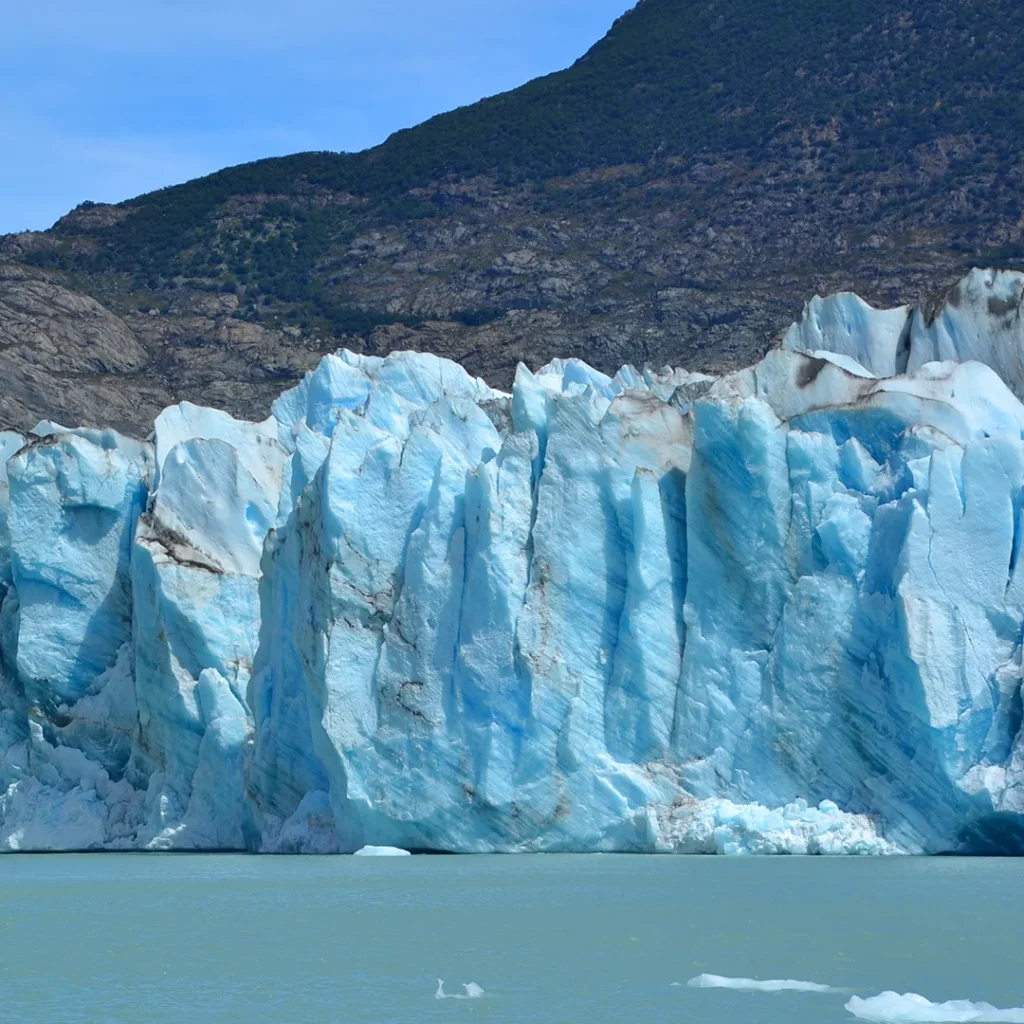

Glacial water is freshwater with very low mineral content, formed from snow that fell centuries ago, but that doesn't automatically make it drinkable: meltwater carries very fine sediment, and once in rivers or lakes, it can contain particles and microorganisms. That's why it's not advisable to drink untreated lake water. Glacial ice, on the other hand, is the star of a classic tradition: toasting in front of the Viedma Glacier.
We've been sailing the lakes of Los Glaciares National Park since 1980, and few questions are as frequently asked on board as this one. Here, we separate fact from legend.
What is glacial water?
A glacier is transformed snow. In high-altitude areas, such as the Southern Patagonian Ice Field, more snow falls than melts. Over the years, the weight of the new layers compacts the layers below, expels much of the air, and turns them into dense ice. This ice flows slowly to the glacier's terminus, where it either melts or breaks off in icebergs.
The result is fresh water with very few dissolved salts, because it comes from snowmelt and not from underground aquifers that seep through rocks. What it does contain is glacial flour : rock ground down by ice as it slides over the lakebed. This is responsible for the turquoise color of the lakes, as we explained in why Lake Argentino is turquoise.
Glacial water: myths and truths
| What is said | Myth or truth? | The explanation |
|---|---|---|
| “It is the purest water in the world” | Half | It has very few minerals, but the melting ice carries sediment and, in contact with the environment, it can become contaminated. |
| “You can drink directly from the lake” | Mito | Even if it looks clean, it's not advisable to take it untreated. |
| “Glacial ice is thousands of years old” | True, with nuances | It is ice that is centuries old; the exact age of each piece cannot be determined with the naked eye. |
| “It crackles in the glass” | Truth | Releases air bubbles trapped under pressure during compaction |
| “It lasts longer than a regular ice cube” | It's usually true | It is very dense ice with little air, although it depends on the size of the piece. |
| “It has healing properties” | Mito | There is no evidence of special health effects |
| “The color turquoise is pollution” | Mito | It's glacial flour, a natural phenomenon |
Is it safe to drink water from the lake or a stream?
The general recommendation is not to drink untreated water from lakes or rivers. Just because water comes from a glacier doesn't guarantee it's safe to drink: along the way, it travels through soil, rocks, and riverbanks, and the suspended sediment can be hard on the stomach. If you're hiking on your own, the National Park provides information about water at its visitor centers; check them before you set out and always carry your own water bottle.
On board our cruises, there's no need to worry about any of this: the boats have a cafeteria, and on the Viedma Adventure, the on-board snack includes mineral water.
Glacial ice in the glass: ice fishing
Ice is another story. On the Viedma Adventure, when the boat approaches the face of the Viedma Glacier, the crew collects a fragment that the glacier itself has already broken off from the lake, breaks it up on board, and uses it for toasts. This is what we call ice fishing . Whether it's done depends on there being suitable fragments within reach and on conditions allowing it.
What's most surprising isn't the taste, but the sound: the ice crackles and pops as it melts, because it releases air that was trapped when the snow compacted. We describe the entire ritual of ice fishing on the Viedma Glacier , and the physics of sound in our article " Why Glaciers Crackle ."
A freshwater reserve to take care of
The Southern Patagonian Ice Field, shared with Chile, is the third largest freshwater reserve on the planet. On the Argentinian side, much of that ice is protected within Los Glaciares National Park, a UNESCO World Heritage Site since 1981. Conserving water starts with simple actions:
- Do not throw anything into the lake, not even organic waste.
- Use the designated restrooms: they are available on our boats, at the Punta Bandera terminal, and at the Spegazzini Refuge.
- Do not use soaps or creams in streams or on shores.
- Take everything you brought back with you.
Toast with ice from the Viedma Glacier
The Viedma Adventure departs from Puerto Bahía Túnel, 18 km from El Chaltén, and lasts 4 hours, from 10:30 AM to 14:30 PM. The tour includes sailing on Lake Viedma, a hike to the viewpoint overlooking Iceberg Bay, a close-up view of the largest glacier in the park, and ice fishing. It departs daily from September to April and every other day plus Saturdays from May to August. If you are staying in El Calafate, you can take the same tour with the Viedma Full Day Adventure . Check the departure schedule, availability, and current rates on the tour's website.
FAQ
Is it safe to drink glacial water?
Glacial water has very few minerals, but it is not advisable to take it directly from untreated lakes or rivers, because it may contain sediment and microorganisms.
Why does glacial ice make noise in the glass?
Because it contains air bubbles trapped under pressure. When it melts, the air is released suddenly, producing popping sounds.
How old is the ice in a glacier?
The ice that reaches the front of glaciers like the Viedma was formed from snow that fell centuries ago. The exact age of each fragment cannot be determined with the naked eye.
Where can you toast with glacial ice?
At the Viedma Adventure, in front of the Viedma Glacier, when conditions permit. It is also part of the Viedma Full Day Adventure from El Calafate.


