

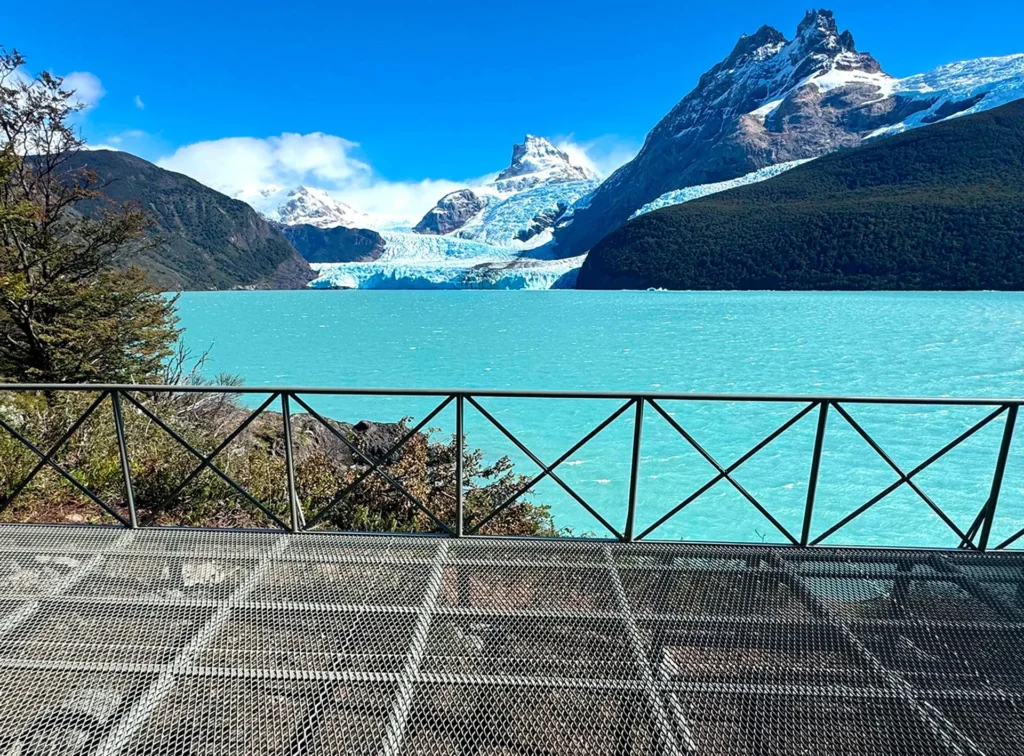
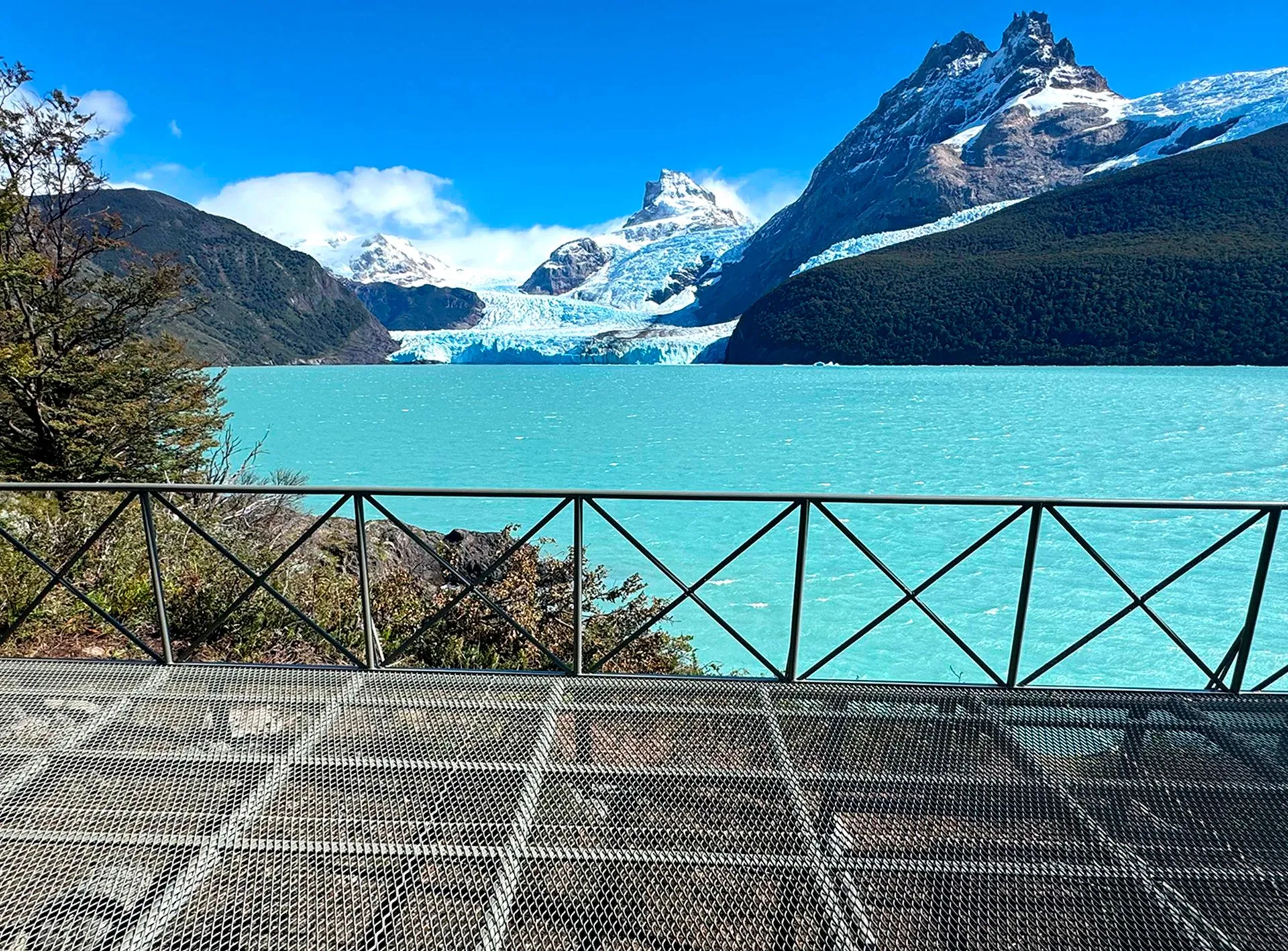
The color of Lake Argentino, that milky turquoise, is due to glacial flour: extremely fine rock particles ground down by glaciers as they slide across the lakebed. These particles remain suspended in the water and scatter sunlight, creating turquoise and greenish hues. The more sediment and the more sunlight, the more intense the color appears. We see it change every day from the boat, and it's one of the most frequent questions we get on board.
It's not a filter or a camera effect. It's real-time geology, and understanding it changes the way you look at the lake.
What is glacial flour?
A glacier is a mass of ice that slowly advances through its valley. Embedded at its base are fragments of rock that act like giant sandpaper: as the ice moves, it scrapes and grinds the bedrock.
The result is a very fine rock powder, finer than sand, which glaciologists call glacial flour or rock flour. Meltwater carries it out of the glacier and into the lake. Because the particles are so small and light, they don't sink immediately: they remain suspended for a long time.
Why is Lake Argentino turquoise?
The key lies in how those particles interact with light:
- Water absorbs red. Pure water more readily absorbs longer wavelengths of light, the red ones, and allows blue wavelengths to pass through. That's why any deep, clean body of water tends toward blue.
- The particles scatter light. The suspended glacial flour bounces light upwards before it is lost in the depths, and favors blue-green tones.
- The background is not visible. The same particles that give water its color also make it less transparent. That's why the lake looks opaque and milky, even though it's clean.
The combination of these three things produces that characteristic turquoise color of Patagonian glacial lakes, which can also be seen in Lake Viedma.
Why does the color change?
Anyone who sails across the lake several times notices it immediately: the same stretch of water is never the same color. Some reasons:
| Factor | How the color changes |
|---|---|
| Sun or clouds | In direct sunlight the turquoise ignites; with overcast skies the lake appears greyish-green. |
| Proximity to a glacier | Near the fronts there is more sediment and the water looks grayer and milkier |
| Station | In the warmer months there is more melting, more sediment, and more intense colors. |
| Wind | The waves mix the water and the surface reflects less of the sky |
| Angle of gaze | From above, for example from a viewpoint, the color appears more saturated than from the shore |
Where is it best viewed while browsing?
On the All Glaciers Navigation tour, the color of Lake Argentino changes throughout the journey. In the open, sunny section of the lake, the turquoise hue is visible in its entirety. Upon entering the North Arm, among the Upsala icebergs, the contrast between the white and blue ice and the milky water is one of the most photogenic sights of the day. We describe it in our article about the North Arm.
At Spegazzini Base, the walkways and viewpoints offer a higher vantage point overlooking Glacier Bay. From there, the differences in color between the water near the glacier and the water in the bay are clearly visible.
Cold and unproductive water
Glacial flour has another, less visible consequence: by limiting the amount of light entering the water, it reduces the growth of microscopic algae. This is why glacial lakes are often biologically unproductive, with cold, nutrient-poor water. It's also why the water doesn't appear dark green like that of a lowland lake, but rather a clear, cool turquoise.
Ice and water tell the same story. If you're interested in why glacial ice appears blue, check out our article on the blueness of ice.
Tips for photographing turquoise
- Look for the sun at your back. With the light behind them, the color of the water becomes saturated.
- Use a polarizing filter if you have a camera. It reduces reflections and lets the color of the water show through.
- I included ice in the painting. An iceberg or the front of a glacier provides contrast and scale.
- Don't overcorrect. The turquoise color of the lake is real; increasing the saturation makes it look artificial.
See the lake with your own eyes
No photo truly captures the color of Lake Argentino on a sunny day. To see it change over a 7-hour boat trip, among icebergs and glaciers, check availability and current rates on the All Glaciers Navigation page.
FAQ
Why is Lake Argentino turquoise?
Because of glacial flour: very fine rock particles ground down by glaciers and left suspended in the water. These particles scatter light and give the lake its milky turquoise color.
Is the water in Lake Argentino dirty because it's not transparent?
No. The lack of transparency is due to glacial flour in suspension, a natural sediment of rock ground by ice, not pollution.
Why does the color of the lake change from day to day?
It depends on the sun or the clouds, the amount of sediment, the proximity to glaciers, the wind, and the angle from which it is viewed.
Where can you best see the turquoise color of Lake Argentino?
It looks more intense in sunlight and from a higher vantage point. During the All Glaciers Navigation tour, it can be seen in the open area of the lake, among the icebergs of the North Arm, and from the viewpoints at Spegazzini Base.


