

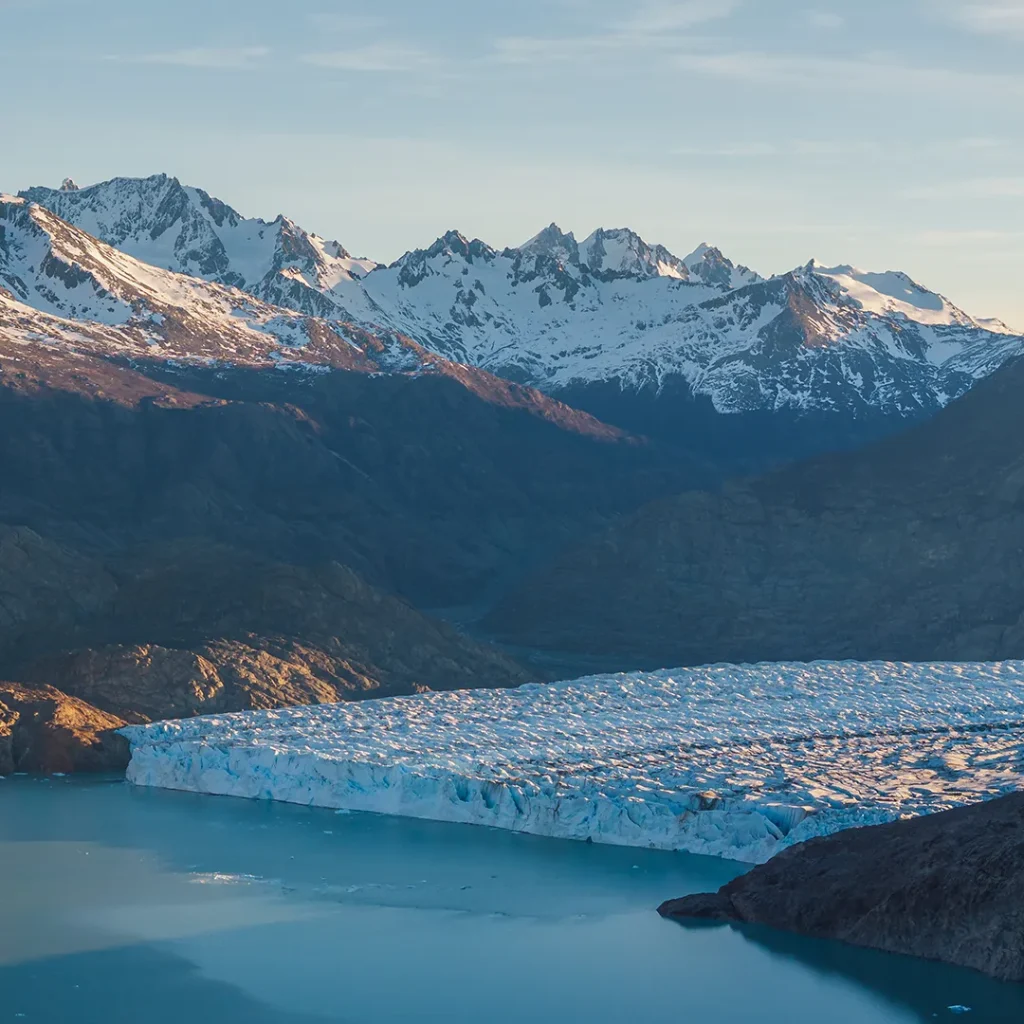

The Huemul Massif is the group of mountains that rises beside Lake Viedma, near El Chaltén, and accompanies much of the Viedma Adventure's sailing route. It is named after the huemul, the Patagonian Andean deer, a National Natural Monument. It can be seen from the boat as we skirt the southern shore of the lake towards the glacier. We have it as our neighbor every time we set sail from Bahía Túnel.
Travelers arrive in El Chaltén thinking of Fitz Roy, and that's understandable. But on the lake, the dominant mountain is another one. This article is to introduce it.
What is the Huemul Massif
A massif is a group of mountains clustered together, with several peaks and slopes forming a single block. The Huemul Massif is just that: a mass of rock and height that rises up around Lake Viedma, in the El Chaltén area, and which from the water appears as a continuous wall of peaks, steep slopes, and, depending on the season, snow at the top.
Its presence orders the landscape of navigation: the turquoise water below, the rock and snow above, and beyond the mountain range from which the Viedma Glacier descends.
Why is it called Huemul?
The name of the Huemul Massif pays homage to the huemul ( Hippocamelus bisulcus ), a robust deer of the southern Andes, adapted to the mountains and forests. It is an endangered species and, in Argentina, has been declared a National Natural Monument, the highest level of protection for a species. It also appears on the coat of arms of Chile, on the other side of the mountain range.
Seeing a huemul in the wild is very difficult: they are few in number, shy, and live in remote mountain areas. Having a mountain named after it serves as a reminder that this region is its home. If you're interested in the local wildlife, we cover it in our article about the fauna of Los Glaciares National Park.
The Huemul Massif from the boat
The Viedma Adventure departs from Puerto Bahía Túnel, 18 km from El Chaltén. During the stretch along the southern shore of the lake, the Huemul Massif is the main feature of the landscape.
- The south coast. Skirting the southern shore of the lake, views of the massif follow one after another.
- Cape Horn Bay. After about 40 minutes we disembarked for an easy walk to a viewpoint overlooking Iceberg Bay, with the Andes Mountains in the background.
- The glacier. Standing in front of the Viedma Glacier, the focus shifts to the ice: blues, crevasses, and the sound of the glacier.
That route is described in detail in the article about the Iceberg Bay and the Viedma walk.
How it changes depending on the light and the weather
| Condition | What the massif looks like |
|---|---|
| Clear day | Sharp outlines, dark rock, and glistening snow above |
| Low clouds | Peaks appear and disappear; the lake takes on a grayer hue |
| Strong winds at high altitude | Lenticular clouds, those elongated and smooth shapes typical of Patagonia |
| Winter | More snow on the slopes, a stark contrast to the turquoise water |
In Patagonia, the sky can change in minutes. A cloud that obscures the summit as you leave Bahía Túnel may have disappeared by the time you return. It's a good idea to look towards the mountain range at different points during your journey.
Tips for viewing and photographing it
- I went out on deck on the stretch of the south coast. That's when the mountain range fills the horizon.
- Use water as a foreground element. The turquoise waters of Lake Viedma, with the occasional wave or iceberg, add depth to the photo.
- Look at the hillsides with zoom. Details of rock and snow appear that are lost at first glance.
- Bundle up. On deck you can feel the wind off the lake; windbreaker, hat and gloves even though it's summer.
The Huemul Massif in one day from El Calafate
If you don't sleep in El Chaltén, the Viedma Full Day Adventure leaves from El Calafate by bus, stops at Parador La Leona, does the same 4-hour navigation on Lake Viedma, with a hike and Viedma Glacier, and adds views of Fitz Roy, a visit to El Chaltén and the short hike to Chorrillo del Salto, in a total of 12 hours of the day.
Sail in front of the Huemul Massif
The Huemul Massif, Lake Viedma, and the largest glacier in Los Glaciares National Park, all in one trip. The Viedma Adventure (10:30 AM to 14:30 PM) and the Full Day (7:30 AM to 19:30 PM) have daily departures from September to April, and from May to August, every other day plus Saturdays. Check the departure schedule, availability, and current rates on the Viedma Adventure website.
FAQ
What is the Huemul Massif?
It's a group of mountains that rises up next to Lake Viedma, in the El Chaltén area. It's one of the main sights during the Viedma Adventure boat trip.
Why is it called the Huemul Massif?
It is named after the huemul, the deer of the Patagonian Andes, an endangered species declared a National Natural Monument in Argentina.
Can you see the Huemul Massif from the boat?
Yes. On the Viedma Adventure, which departs from Puerto Bahía Túnel 18 km from El Chaltén, the boat skirts the southern shore of Lake Viedma with views of the Huemul Massif.
Can you see huemul deer from the boat?
It's very difficult. Huemul deer are scarce, shy, and live in mountainous areas that are difficult to access, so seeing them in the wild is exceptional.


