

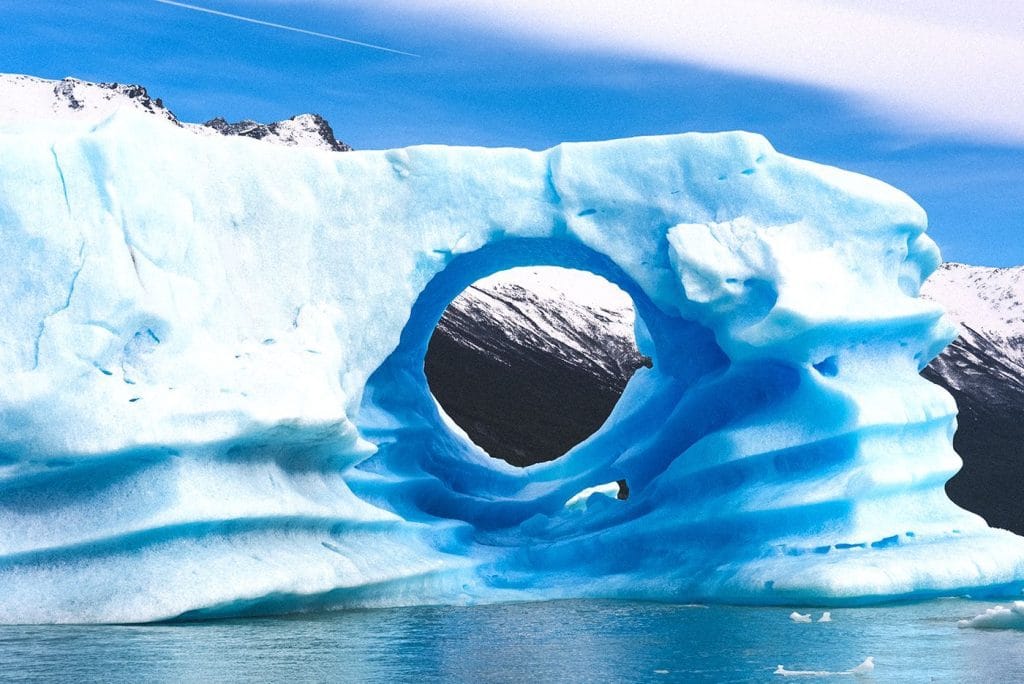
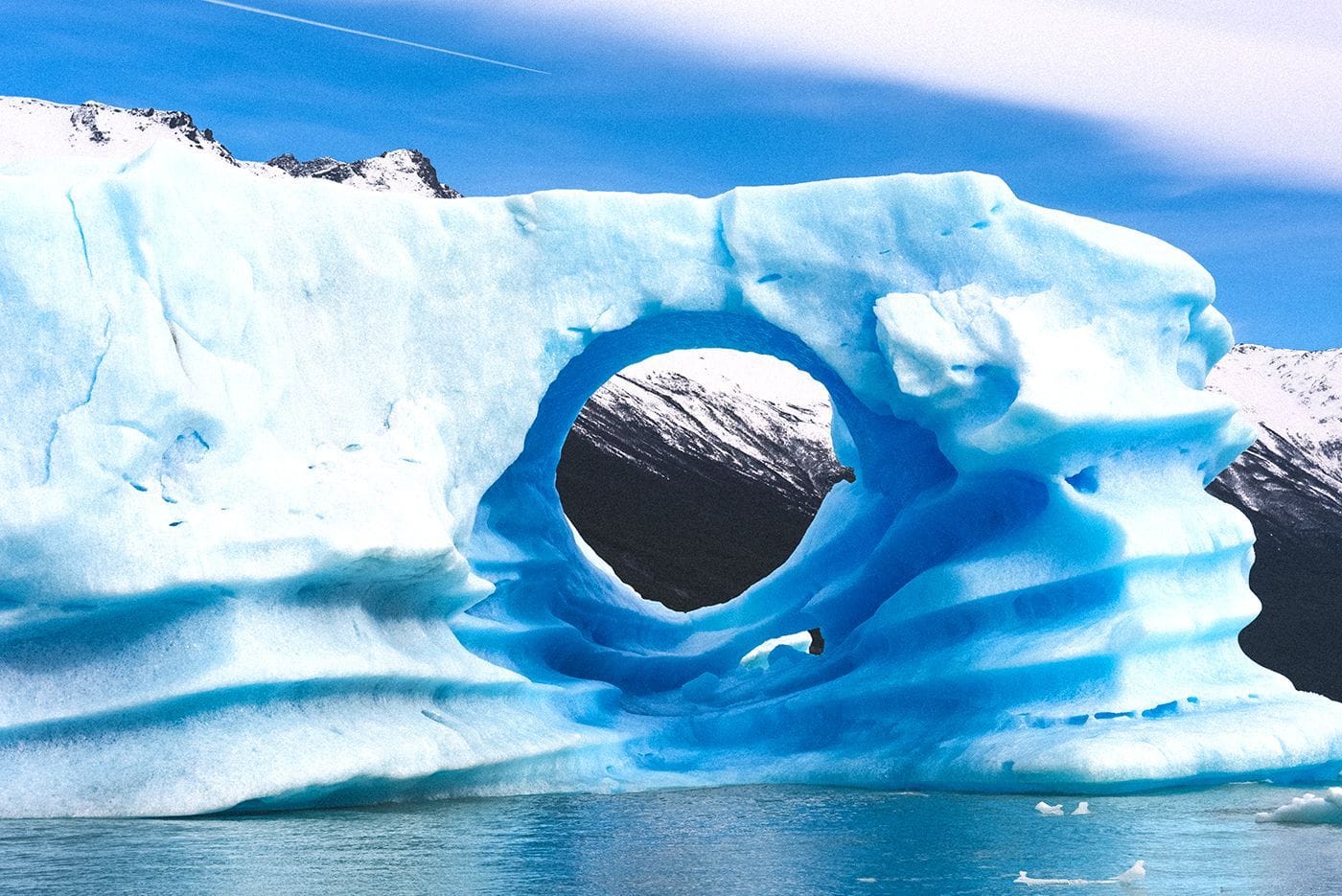
Glaciers appear blue because glacial ice is very dense and contains almost no air bubbles. When light passes through it, the ice absorbs the colors at the red end of the spectrum more strongly and allows blue light to pass through. The more compact and thick the ice that the light travels through, the more intense the blue appears.
We see it every day from the deck, facing the Spegazzini or among the icebergs of the Upsala, and it's the question our guides get asked most often. Here's the full explanation, no formulas.
Why glaciers are blue: the physical explanation
Sunlight is white because it contains all colors. When it enters a material, each color can pass through, bounce off, or be absorbed. Water, and ice as well, absorb slightly more red and orange light than blue. In a glass of water or an ice cube in the freezer, this difference is imperceptible because the light travels a very short distance. In a glacier, however, the light passes through meters of ice before returning to our eyes, and along that path, the reds are lost. What survives is blue.
It's not a reflection of the sky. That's why glaciers appear blue even on completely cloudy days, and sometimes even more so: with diffused light, without strong reflections on the surface, the internal color of the ice is more clearly visible.
Why isn't all ice the same shade of blue?
If blue depends on the path of light, air is its enemy. Bubbles scatter light in all directions and reflect it back before the ice can filter out the reds: the result is white, as with snow or freezer ice.
Glacial ice forms from snow that accumulates year after year in the ice field. Under the weight of the overlying layers, the snow compacts, loses air, and slowly transforms into increasingly dense ice. This process takes a long time. That's why:
- The surface usually appears white.It is exposed to the sun, wind and rain, which fracture it and introduce air.
- The cracks and newly detached surfaces appear deep blueThey show internal ice that is compact and bubble-free.
- Upside-down icebergs are usually the bluest.The part that was underwater is dense ice that was never exposed to the elements.
- The dark bands are not another type of ice: are rock and sediment that the glacier carries.
Where to see the deepest blue while sailing
| Tour location | What to look for |
|---|---|
| Icebergs of Uppsala | Newly overturned blocks, with smooth, deep blue faces |
| Spegazzini Front | Vertical cracks in walls up to 135 m above the lake |
| Heim Glacier | Details of cracks near the coast |
| Viedma Glacier Front | Bluish tones and deep cracks, in the Viedma Adventure |
At Todo Glaciares, the Upsala ice field is the best place to see the blue ice up close, because the icebergs float just a few meters from the boat. If you want to understand why these icebergs only show a portion of their size, read about why icebergs float and how much of them remains underwater.
Turquoise water: another phenomenon, another cause
The color of Lake Argentino and Lake Viedma cannot be explained in the same way as the color of ice. Glaciers grind the rock they advance over, producing a very fine sediment known as glacial flour, which remains suspended in the water. These particles scatter light, giving the lake its milky turquoise hue. We explain this in more detail in " Why Lake Argentino is Turquoise ."
Tips for photographing the blue of ice
- Take advantage of cloudy days: even lighting enhances color without glare.
- Lower the exposure a little. on the cell phone or camera; the white of the surface tends to "wash out" the blue.
- Use polarized sunglasses or a polarizing filter to cut the reflection of the water.
- Look for the new faces: a freshly broken or capsized iceberg is where the blue looks purest.
See it with your own eyes
No photo truly captures the blue of an iceberg just meters from the ship. On the All Glaciers Cruise, you'll see it nestled among the Upsala icebergs and opposite the Spegazzini; check availability and current rates on the tour's website.
FAQ
Why are glaciers blue?
Because glacial ice is very dense and has almost no air. As light passes through it, it loses the red tones, which the ice absorbs more, and what reaches our eyes is blue.
Is the blue of the glacier a reflection of the sky?
No. It's the natural color of compacted ice. That's why glaciers appear blue even on cloudy days.
Why do some parts of the glacier appear white?
Because they have trapped air or are fractured by the weather. The bubbles scatter the light and reflect it back as white, like snow.
Why are some icebergs bluer than others?
The bluest ones are usually the ones that turned over: they show the part that was submerged, which is dense ice without bubbles.


