

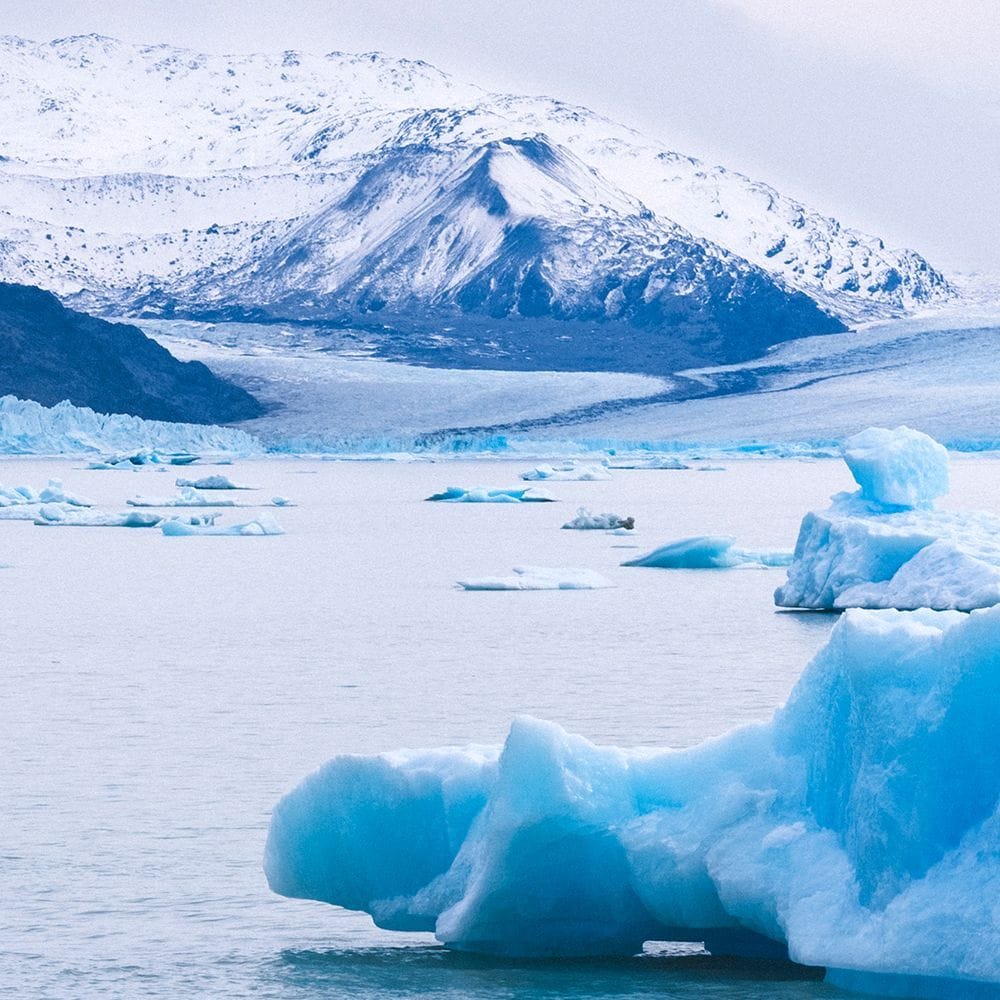
The icebergs in Lake Argentino are blocks of ice that break off from the front of glaciers, especially the Upsala Glacier. They float because ice is less dense than water, but only a small portion is visible: in freshwater, around 90% of an iceberg's volume remains submerged. What you see is just the tip.
We've been sailing among icebergs since 1980, and no two trips are ever the same: the ice field changes shape every day. Here's what we know about them, and what we tell people on board when they ask.
Where do the icebergs of Lake Argentino come from?
A glacier is a river of ice that slowly advances from the Southern Patagonian Ice Field. When its terminus reaches the lake, the ice rests on the water or partially floats; the resulting tension fractures it, and entire blocks break off. This process is called calving. Each block that falls becomes a new iceberg.
On the All Glaciers Navigation tour, most of the icebergs we see come from the Upsala Glacier, one of the largest in South America, covering 765 km². That's why the northern arm of the lake, where it flows into the glacier, has the most floating ice on the entire route. We describe this area in more detail in our article about the northern arm of Lake Argentino.
Why do icebergs float?
Water has an unusual property: when it freezes, it expands. Its molecules arrange themselves in a crystalline structure with more space between them than in liquid water. As a result, ice weighs less than the same volume of water, and that's why it floats.
The difference, however, is small. Ice has a density close to 90% that of fresh water, and this proportion defines how much it sinks: an iceberg floats with about nine-tenths of its mass below the surface. In the sea, where salt water is somewhat denser, a little more of it is visible above the surface; in a freshwater lake like Lake Argentino, even less is visible.
How much is underwater: the tip rule
| What you see | What there is |
|---|---|
| An iceberg that stands out like a house | Below it is a much larger, irregularly shaped block |
| A low, wide iceberg | It can extend underwater far beyond its visible edge |
| An iceberg with smooth, blue faces | It probably flipped over recently and is showing the part that was submerged. |
This explains why ships keep their distance: the submerged part isn't necessarily directly beneath the visible part, and an iceberg can rotate without warning. The captain decides the approach based on the ice conditions each day.
Why do icebergs flip over?
An iceberg melts unevenly: the lake water erodes it from below while the sun, rain, and wind work on the exposed part. As its shape changes, so does its point of equilibrium. Eventually, its position becomes unstable, and the block rotates, sometimes abruptly, revealing ice that was previously submerged.
The newly exposed face is usually the bluest because it's compact ice without bubbles. We explain this in why glacial ice is blue.
What happens to an iceberg throughout its life
- It was created as it detaches from the glacier's front.
- Drift pushed by the wind and the lake currents.
- You may get stranded in shallower areas, where it remains still until it melts enough to float again.
- It transformsIt splits, turns over, and is sculpted by water and wind into the shapes of arches, towers, or caverns.
- It melts and returns to the lake as fresh water.
How long it lasts depends on its size, the water temperature, and the weather at that time of year. That's why no two trips offer the same scenery.
How to see and photograph them from the boat
- I went out on deck as the ship entered the north arm, past the Devil's Mouth.
- Look for backlit scenes and recently turned faces to see the most intense blues.
- I included some reference points in the photo, such as the coast or the railing, to show the size.
- On cloudy days the blue of the ice looks even better than in strong sunlight.
Sail among the icebergs of Uppsala
The ice field is one of the most photographed sections of the All Glaciers Navigation tour , which continues to Spegazzini and ends with disembarkation at Spegazzini Base. Check availability and current rates on the tour's website.
FAQ
Why do icebergs float?
Because water expands when it freezes, and ice is less dense than liquid water. This difference causes the block to float, although most of it is submerged.
How much of an iceberg is underwater?
In freshwater, such as that of Lake Argentino, around 90% of the volume of an iceberg remains below the surface.
Where do the icebergs in Lake Argentino come from?
They calve from the front of glaciers. Those seen on the All Glaciers Navigation tour mostly come from the Upsala Glacier.
Why do some icebergs flip over?
Because they melt unevenly and their equilibrium point changes. When the position becomes unstable, the block rotates and exposes the part that was submerged.


