

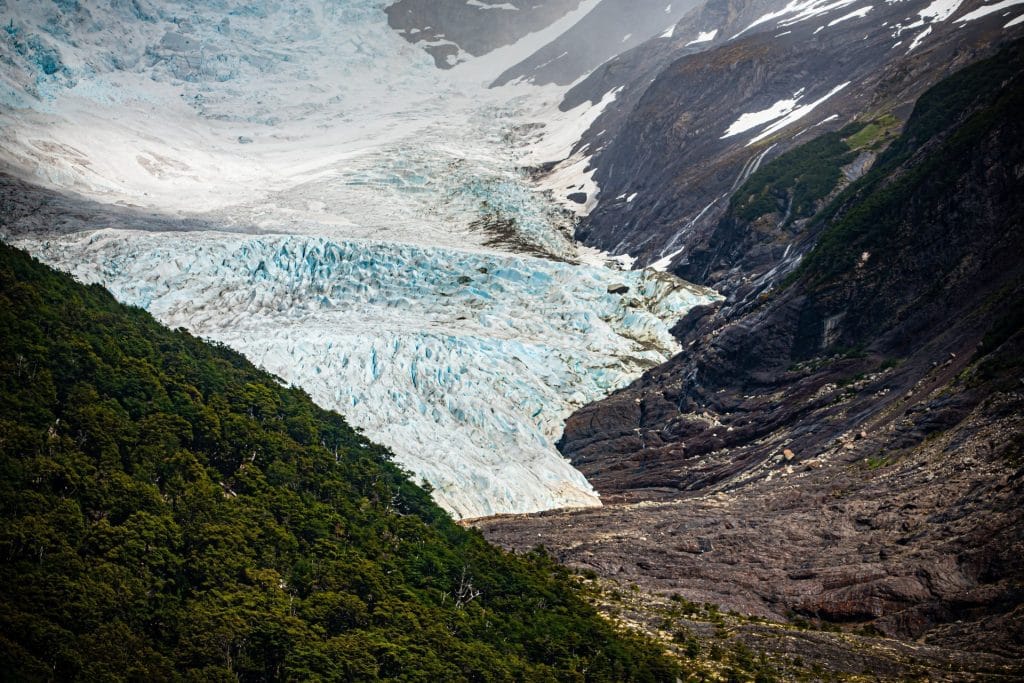
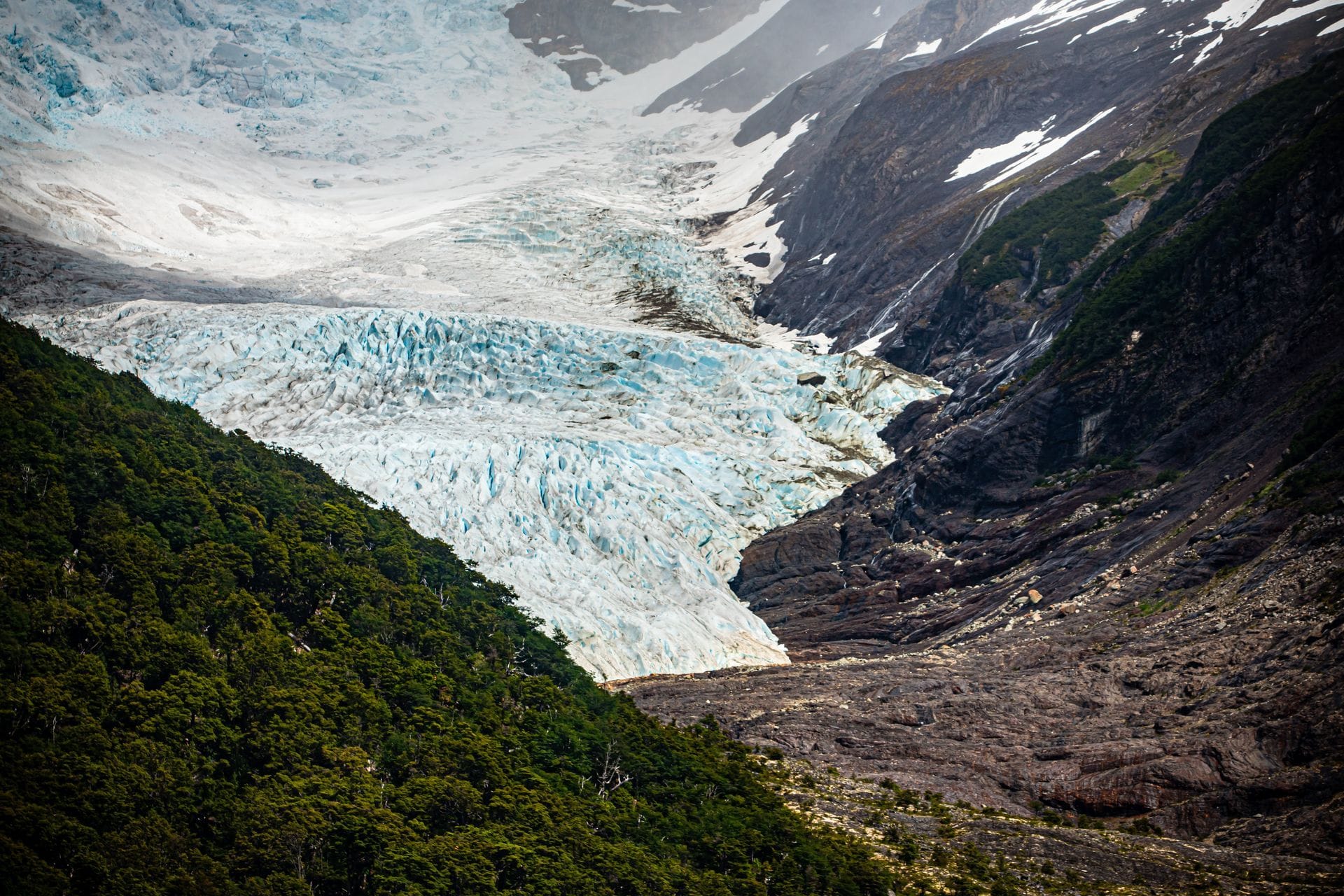
The Dry Glacier is a hanging glacier in Los Glaciares National Park: it descends the mountainside but ends before reaching Lake Argentino. It remains suspended because, halfway down the slope, the ice is lost through melting and calving at the same rate at which it advances. It can be seen from the boat on the All Glaciers Navigation tour.
We pass by the Seco Glacier on every trip to Glacier Bay, since 1980. It is one of the glaciers that arouses the most questions on board, precisely because it is not like the others: it does not have a face above the water nor icebergs at its feet.
What is a hanging glacier?
A hanging glacier is a glacier that originates in a cirque or high valley and terminates over a steep slope or rocky outcrop, without reaching the valley floor. Seen from the lake, it resembles a tongue of ice clinging to the mountain, abruptly cut into the air.
Glaciers that terminate in water, like the Upsala or the Spegazzini, are called calving glaciers: their terminus rests on the lake and releases icebergs. The Seco belongs to another category, and seeing it on the same route helps to understand that not all glaciers function the same way.
Why the Dry Glacier doesn't reach the water
Every glacier has a balance. Above, in the accumulation zone, it gains mass from the snow that falls and compacts. Below, in the ablation zone, it loses mass through melting, evaporation, and calving. The terminus is located where these two forces balance each other.
- Smaller watershed. Hanging glaciers typically have small basins compared to the large glaciers that flow down from the Southern Patagonian Ice Field. They receive less ice.
- Steep slope. On a very steep slope, the ice fractures and breaks off in blocks that fall down the mountain before forming a continuous tongue to the lake.
- More exposure. Since it ends at a lower altitude than its head and without the protection of a deep valley, the front is exposed to the sun and wind.
The result is a glacier that “hangs”: its front is halfway down the slope, and what is lost there returns to the lake as meltwater or as ice that collapses down the slope.
Why is it called Seco?
The name seems to perfectly describe what you see from the lake: a glacier that doesn't touch the water. Unlike glaciers that terminate in the lake, the Seco Glacier doesn't have a wetted front or its own icebergs floating in front of it. If you're interested in the origin of the names of the other glaciers, we explain it in Spegazzini, Upsala, Viedma, Moreno: the origin of the names.
Dry Glacier, Heim and Spegazzini: three ways to end
| Glacier | How it ends | What can you see from the boat? |
|---|---|---|
| Dry | Hanging on the hillside, without reaching the water | A tongue of ice suspended in the mountain |
| Home | Near the coast, smaller in size | Textures and cracks at close range |
| Spegazzini | Lakefront, walls up to 135 m | The highest glacier in the Park and its calving |
| Uppsala | Lakefront, 765 km² of surface area | The icebergs it releases in the northern arm |
The order of the route is precisely what allows for comparison: after the icebergs and the face of the Upsala Glacier, the ship passes by the Seco Glacier, then the Heim Glacier, and finally the Spegazzini Glacier. We detail this in the " What You See" section of "All About Glaciers ."
How to view it (and photograph it) from the deck
- Look up. Unlike lakefront glaciers, the Seco faces upwards, on the hillside.
- I followed the line of the ice. Notice where the tongue ends and what's underneath: polished rock, vegetation, or trickles of meltwater.
- Use the zoom. The hanging front shows cracks and fractured blocks that are easily missed.
- Frame the entire mountain. The most revealing photo is the one that shows the glacier, the slope and the lake in the same frame: that's where you understand why it "hangs".
The ship's exterior decks are designed for this. Bring a jacket: near the glaciers, the wind chill is low even in summer.
A glacier to read the landscape
The Seco Glacier illustrates, in a single image, how slope, altitude, and snowpack define the extent of a glacier. Our guides explain it on board, and at Spegazzini Base, the glaciology interpretive stations provide further insight as you walk through the forest.
Come and see the Dry Glacier
The Dry Glacier is part of the All Glaciers Navigation tour , along with the Upsala, Heim, Peineta, and Spegazzini glaciers, with disembarkation at Spegazzini Base. Check availability and current rates on the tour page.
FAQ
What is a Dry Glacier?
It is a hanging glacier in Los Glaciares National Park: it descends down the mountainside but ends before reaching Lake Argentino.
What is a hanging glacier?
It is a glacier that originates in a high valley or cirque and ends on a steep slope, without reaching the valley floor or the water.
Why doesn't the Dry Glacier reach the lake?
Because its front loses ice through melting and calving at the same rate as it advances. Its basin is small and its slope steep, so the front remains halfway up the slope.
Which tour includes a visit to the Dry Glacier?
The All Glaciers Navigation, which departs from Puerto Punta Bandera, allows you to see five glaciers: Upsala, Seco, Heim, Peineta and Spegazzini.


