

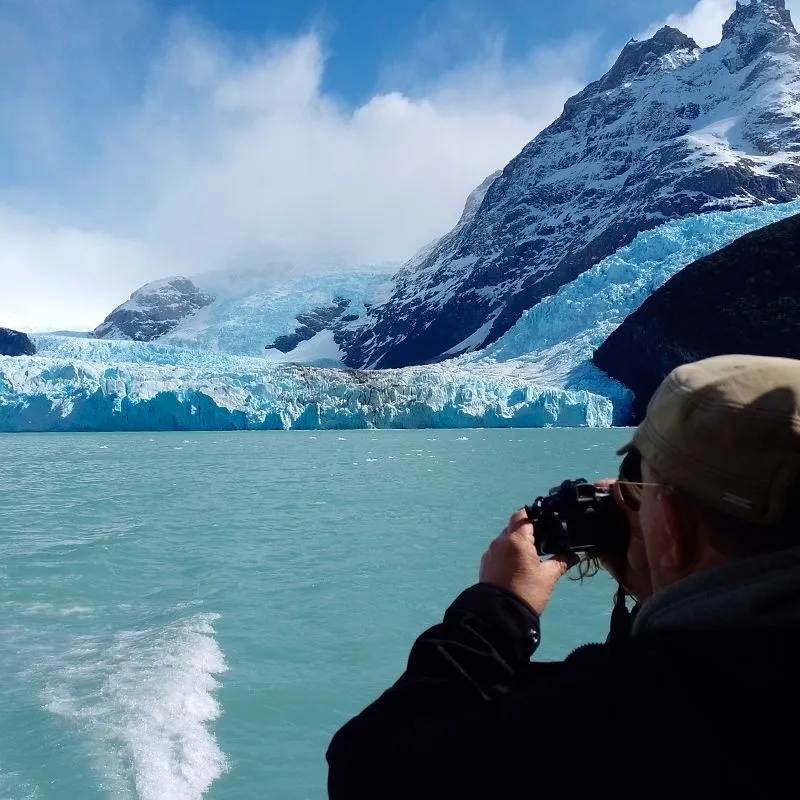
To photograph glaciers from the ship, go out on the outer deck, lower the exposure slightly so the ice doesn't appear blown out, use optical zoom instead of digital, and find a scale: an iceberg, a coastline, or the ship itself. Cloudy days aren't a problem; they enhance the blue of the ice.
Since 1980, we've seen thousands of cameras and cell phones pass by our cabins, and we've learned what works and what doesn't. These are the tips we give our passengers before they arrive at Upsala.
Where to find your spot on the ship
Our catamarans have exterior decks designed for photography. Some key features:
- I left before arriving. When a glacier approaches, the railings get crowded. If you leave a few minutes early, you can choose your spot.
- Bow and sides: The bow shows what's coming; the sides are ideal when the ship stops in front of a glacier.
- Turnate: There's time for everyone when you're looking at the glacier. Take your photos and give up your spot: the best photo is also the one that doesn't make you miss the moment.
- Inside the hall: Large windows are useful for background photos, but reflections and water droplets complicate the main shots. If you're photographing through glass, hold the lens against it.
How to photograph glaciers: ice exposure
The most common error is "burned" ice: a white patch with no texture. This happens because the camera tries to compensate for so much light surface area.
- With cell phone: Tap the screen over the glacier and lower the exposure control (the sun icon) slightly. You'll recover the cracks and blue tones.
- With camera: Apply negative exposure compensation and check the histogram. A slightly dark photo is preferable to a white photo with no detail.
- RAW format, If your equipment allows it: it gives more room to recover highlights in editing.
- polarizing filter: It reduces reflections on water and ice and deepens the blue. Rotate it until you see the effect.
The light: sun, clouds and sunset
Many people complain when it's a cloudy morning. There's no need to: with overcast skies, the light is even, there are no harsh shadows, and the blue of the ice appears more intense. With strong sunlight, on the other hand, the ice shines brightly, and you should be more careful with your exposure.
| Condition | What to take advantage of |
|---|---|
| Cloudy | Deep blues, ice texture, icebergs |
| full sun | Blue skies, reflections in the lake, contrast with the forest |
| Wind | Textured lake, moving clouds over the mountains |
| Sunset | Warm light on the ice walls |
If you are interested in the light of the last part of the day, there is the All Glaciers Sunset variant.
Icebergs, scale and composition
A glacier without a frame of reference can appear small in a photograph. To convey its size:
- I included an iceberg or the coast in the foreground. The icebergs of the Upsala Glacier, in the North Arm, are ideal for that.
- Add people or a part of the ship: a railing or the silhouette of another passenger provides scale.
- Use the lake line: Keep it straight; with the movement of the ship it's easy for it to become crooked.
- Zoom in using the optical zoom Focus on the cracks and textures. Avoid digital zoom: it degrades the image.
- Burst: If you see a landslide or a bird in flight, the burst of light increases the chances of capturing the perfect moment.
To photograph icebergs effectively, it helps to know how they work: we explain this in why icebergs float.
The best shots from the All Glaciers Navigation
On the All Glaciers Navigation, each section offers a different view:
- Devil's Mouth: the natural strait through which you enter the North Arm; good mountain and water shots.
- Icebergs of Uppsala: Unique shapes and shades of blue. It's the most photographed stretch.
- Upsala Glacier: 765 km² of ice. Look for a broad composition.
- Dry Glacier: a hanging glacier that does not reach the water; frame the rock wall that supports it.
- Heim and Spegazzini Glaciers: Spegazzini is the tallest cliff in the park, with walls up to 135 meters above the lake. Its verticality is best appreciated from the boat.
- Spegazzini Base: From the walkways, the De Agostini viewpoint, and the new, higher viewpoint closer to the glacier, you can see Spegazzini, Heim, and Peineta. From the mainland, you can use slower speeds and carefully frame your shots without the movement of the ship.
Protect your equipment in the cold and wind
- Battery: The cold will drain it faster. Carry a spare or an external battery in an inside pocket.
- Correa always: On deck, in windy conditions, secure your cell phone or camera with a strap or cord.
- Lens drops: Bring a microfiber cloth; the lake spray reaches the deck.
- Thin gloves: Those that allow the use of the touch screen are a great ally.
- Drones: In the National Park, its use is regulated; do not fly without the corresponding authorization from National Parks.
Take home your best photos of Upsala and Spegazzini
With these tips, you'll return with photos that truly capture the feeling of being surrounded by ice. And if at any point the best decision is to lower your camera and simply observe, that's perfectly fine too. Check availability and current rates on the All Glaciers Navigation website.
FAQ
How to prevent the glacier from appearing white in the photo?
Lower the exposure: On your phone, tap the screen on the glacier and slide the exposure control down; on your camera, use negative exposure compensation. This will bring back the cracks and blue tones.
Is it possible to go on deck to take photos of the glaciers?
Yes. Solo Patagonia's catamarans have exterior decks designed for photography; it's a good idea to get off a few minutes before arriving at each glacier to choose your spot.
Is it better to photograph glaciers in the sun or on cloudy days?
Both conditions work. With cloudy skies, the light is even and the blue of the ice appears more intense; with sunshine, there is more contrast, and it's important to be careful with the exposure.
Where are the best photos from the All Glaciers Navigation?
The icebergs of the Upsala Glacier, the Spegazzini Glacier from the boat and the walkways and viewpoints of the Spegazzini Base, from where you can see Spegazzini, Heim and Peineta.
Is it permitted to fly drones in Los Glaciares National Park?
Its use is regulated by National Parks: do not fly a drone without the corresponding authorization.


