

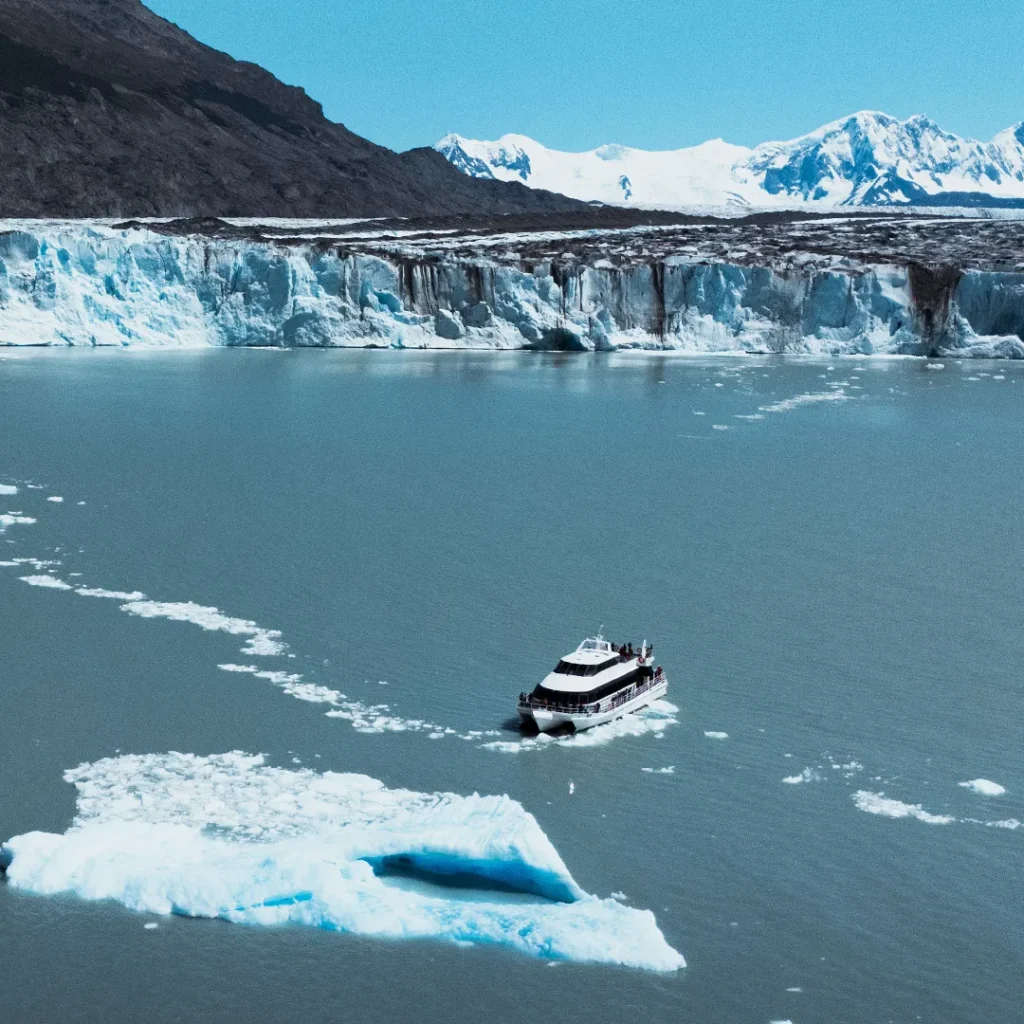

The wind blows strongly on Lake Viedma because the lake is open to westerly winds that cross the Andes and descend dry and swiftly toward the steppe. This is compounded by the cold air that descends from the Viedma Glacier. Navigation is done in specially equipped catamarans, with crews who understand the lake and the captain's decisions.
We know the Patagonian wind firsthand: we've been sailing the lakes of Los Glaciares National Park since 1980. This article explains what happens on the Viedma and what you can expect on the day of your sailing trip.
Where does the wind come from on Lake Viedma?
At these latitudes, westerly winds prevail, traveling across the Pacific without any mountains to impede them. Upon reaching the Andes, the air rises, cools, and releases its moisture as rain and snow over the mountain range and the Southern Patagonian Ice Field. On the other side, it descends dry and fast. This is why the western side of the Park is wet and snowy, while the eastern steppe is dry and windy.
Lake Viedma lies precisely at that transition: its western end touches the ice and its eastern end opens onto the steppe. The wind blows along its length, and the more free space it has to blow across the water, the larger the waves become.
The wind coming down from the glacier
There's a second, more localized wind: the one that descends from the ice. The air in contact with the glacier cools, becomes denser, and falls down the slope due to gravity. This is what glaciologists call a katabatic wind. That's why, near the front of the Viedma Glacier, even on a sunny day, you feel an icy breeze coming directly from the ice.
That cold air is part of the experience: the smell of ice, the sound of fracturing ice blocks, and the sudden drop in temperature as the ship approaches. We describe it in detail in our article about the Viedma Glacier, the largest in the park.
When does it blow the most?
The wind is generally stronger between spring and summer, and usually calmer in autumn and winter. But in Patagonia, the rule has many exceptions: there are summer days with mirror-like waters and winter days with gusts. The important thing is that the wind changes quickly, sometimes in minutes, and that's why the crew follows it throughout the voyage.
| Station | Wind in general | What to notice on board |
|---|---|---|
| Spring | On the rise | Gusts and changing skies |
| Summer | The most frequent | Suction covers, plenty of light |
| Fall | It usually loosens | Lake more serene, warm light |
| Winter | More often calmer | Cold, dry air, snowy mountains |
How we navigate the Viedma with wind
The Viedma Adventure departs from Puerto Bahía Túnel, 18 km from El Chaltén, and sails along the southern shore of the lake, with views of the Huemul Massif. After approximately 40 minutes, it arrives at Cabo de Hornos Bay, where we disembark to walk to a viewpoint overlooking Iceberg Bay. Afterward, we return to the boat to approach the face of the glacier.
- Stable catamarans: The two hulls distribute the support on the water and make navigation more stable than that of a single hull.
- Closed booths: If the wind picks up on deck, you follow the route from inside, behind the windows, and go out at key moments.
- Captain's decision: Once underway, the captain can adjust the route for safety, for example the distance to the front of the glacier or the order of the stops.
The official policy is clear: navigation is not suspended due to bad weather; in the event of an extraordinary episode, the situation is evaluated on a case-by-case basis.
Tips for your day at Lake Viedma
- Windbreaker jacket: It's the most important garment. The wind on the water is much colder than the thermometer.
- Hat properly fitted: A loose hat on the deck of the Viedma ends up in the lake.
- Sunglasses: They protect against the reflection of water and ice, and also against the wind in the eyes.
- Closed shoes: The walk to the viewpoint is easy, but the terrain is natural.
- Cell phone with a strap or held securely: The bursts of light surprise you just as you take the photo.
If you're worried about seasickness, read our article on seasickness while sailing : the advice also applies to the Viedma. And if you want to understand the wind patterns of the entire region, continue reading about the Patagonian wind and how to travel with it.
Navigate the Viedma with someone who knows it
The Viedma Adventure lasts 4 hours, from 10:30 AM to 14:30 PM, and includes disembarkation, a walk to the viewpoint, a close approach to the glacier, ice fishing, and a snack on board. It departs daily from September to April and every other day plus Saturdays from May to August. Check availability and current rates on the tour's website.
FAQ
Why is there so much wind on Lake Viedma?
Because it is exposed to the dry westerly winds that descend from the mountain range, and because the cold air from the Viedma Glacier flows down towards the lake. The wind travels the length of the lake and raises waves.
Is the Viedma Adventure cancelled if there is wind?
Sailing is not suspended due to bad weather; in the event of an extraordinary weather event, the situation is evaluated on a case-by-case basis. Once underway, the captain may adjust the route for safety reasons.
When is there less wind in Viedma?
In general, autumn and winter are calmer, and spring and summer are windier. However, the Patagonian climate changes rapidly in any season.
What is a katabatic wind?
It's the cold, dense air that descends by gravity from a glacier. It's what you feel as an icy current when the ship approaches the face of the Viedma Glacier.


