

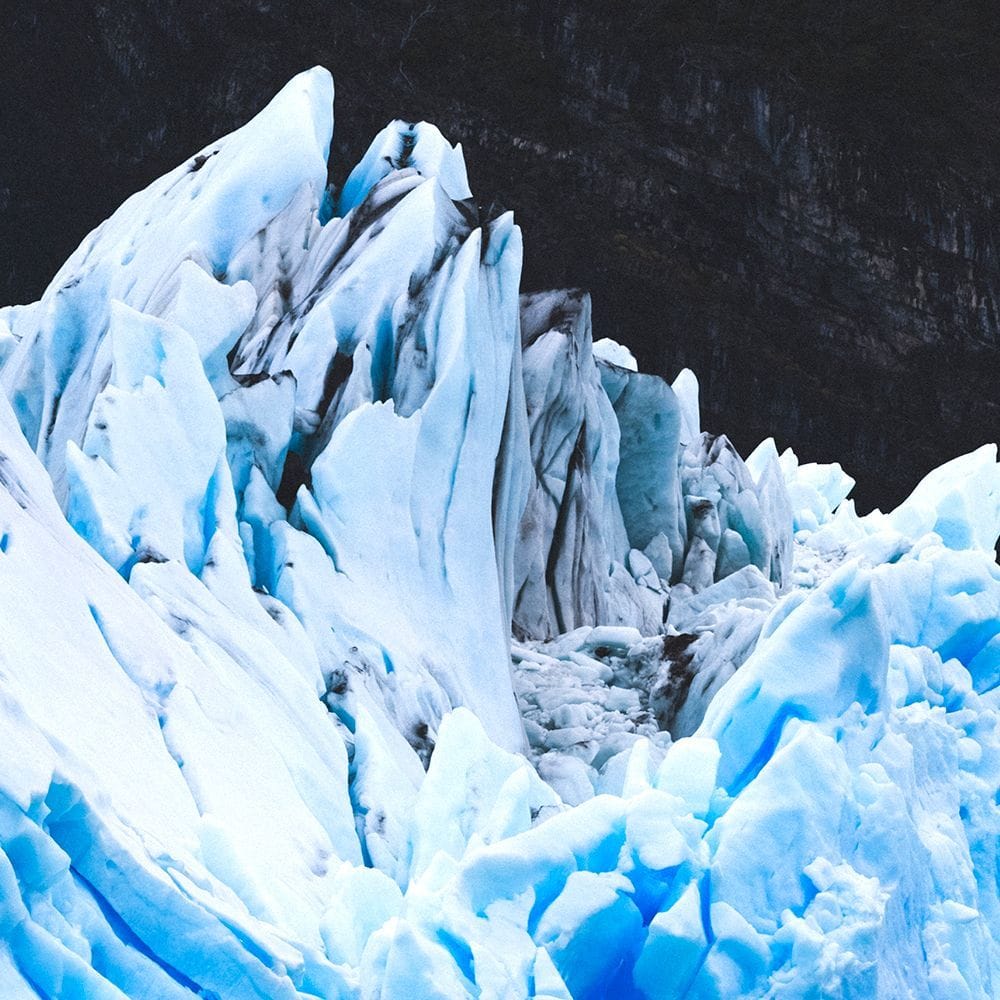
This glossary of glaciers brings together 30 words to understand ice: how a glacier forms (snow, firn, glacial ice), how it moves and loses mass (ablation, calving, retreat), what shapes it leaves in the landscape (moraines, U-shaped valleys, lakes) and what its surface looks like (cracks, seracs).
These are the words our guides have been using on board for decades. We've been sailing among glaciers since 1980, and we know that when you understand the terms, the landscape is interpreted in a whole new way.
Glossary of glaciers: how ice is born
- Glacier: mass of ice formed by the accumulation of snow over many years, which moves by its own weight.
- Icefield: A vast expanse of ice covers the landscape and feeds several glaciers simultaneously. The Southern Patagonian Ice Field, shared with Chile, feeds the glaciers in the Park. We tell you about it in the Southern Patagonian Ice Field.
- Snow (firn): Snow that has survived at least one summer and has begun to compact. It is the intermediate stage between snow and ice.
- Glacial ice: Dense ice resulting from the compaction of sleet. It traps small air bubbles from the time the snow fell.
- Accumulation zone: upper sector of the glacier where more snow falls than melts in a year.
- Ablation zone: lower sector where the glacier loses more than it receives.
- Equilibrium line: boundary between both zones, where gains and losses are balanced.
- Mass balance: The annual balance between what the glacier gains and loses. If it is negative for several consecutive years, the glacier retreats.
How it moves and how it loses mass
- Glacial flow: The movement of ice downhill. Ice deforms slowly, like a plastic material, and can also slide on its base.
- Ablation: all the ways in which the glacier loses ice: melting, evaporation, and calving.
- Discharge glacier: An ice tongue that descends from an ice field into a valley or lake. The Upsala and Spegazzini are examples.
- Hanging glacier: A glacier that hangs on the mountainside and doesn't reach the water. A dry glacier is the type you see when sailing; we explain it in... the Dry Glacier.
- Detachment: The fall of blocks of ice from the glacier's front into the lake. This is the most spectacular form of ablation.
- Iceberg: A detached block of ice floats on the lake. A large part of its volume remains underwater.
- Recoil: when the front of a glacier moves further and further back. The Upsala Glacier is one of the most studied cases in the Park.
- Advance: On the contrary: the front gains ground because the glacier receives more ice than it loses.
The surface of the glacier: what you see from the boat
- Front: The final face of the glacier, where it ends in the lake or on land. The Spegazzini glacier has walls up to 135 m high above the lake.
- Language: the elongated part of the glacier that descends through the valley to the front.
- Crack: open fracture in the ice, resulting from the stresses of movement.
- Serac: A block or tower of ice that remains between intersecting crevasses. We dedicate an article to it. cracks and seracs.
- Mill (moulin): vertical shaft through which meltwater enters the glacier.
- Blue Ice: Very compact ice, with few bubbles, that absorbs red light and reflects blue.
The traces it leaves on the landscape
- Moraine: Accumulation of rocks and sediments that the glacier pushes or transports. It can be lateral, frontal, or central (when two tongues join).
- Erratic block: large rock that the ice moved far from its place of origin and left behind when it retreated.
- U-shaped valley: A valley with steep walls and a wide bottom, carved by a glacier. Rivers, on the other hand, tend to form V-shaped valleys.
- Glacial cirque: amphitheater-shaped hollow at the head of a mountain glacier.
- Nunatak: rocky summit that rises above an ice field.
- Glacial striations: streaks that the ice, laden with stones, marks on the rock as it passes.
- Glacial flour: Very fine rock dust that the glacier grinds and carries to the lake. This is the reason for the turquoise color of Lake Argentino.
- Proglacial lake: A lake that forms in front of a glacier, in the space left by the glacier or enclosed by its moraines.
How to use this glossary in navigation
On the All Glaciers Navigation tour, you can check off terms one by one. At Boca del Diablo (Devil's Mouth), you'll see slopes polished by ice; opposite Upsala Glacier, icebergs and a retreating discharge glacier; Seco Glacier shows you what a hanging glacier is; and Heim and Spegazzini Glaciers feature crevasses and seracs. Later, at Spegazzini Base, the interpretive stations along the trail review glaciology, history, fauna, and flora.
If you want to delve deeper into the classification, continue with types of glaciers.
Put a name to what you see
The five glaciers of Todo Glaciares—Upsala, Seco, Heim, Peineta, and Spegazzini—are an open-air classroom. Boat trips depart daily from September to April and every other day from May to August. Check availability and current rates on the tour's website.
FAQ
What is the difference between a glacier and an ice field?
An ice field is a large expanse of ice covering the landscape; glaciers are the tongues of ice that descend from it into valleys and lakes. The Southern Patagonian Ice Field feeds the glaciers of Los Glaciares National Park.
What is glacial ablation?
It is the loss of ice through melting, evaporation, and calving. It is concentrated in the lower part of the glacier, near the terminus.
What is a serac?
It's a block or tower of ice that becomes isolated between intersecting crevasses. They are clearly visible at the glacier fronts from the deck of a ship.
Why is Lake Argentino turquoise?
Because of glacial flour: a very fine rock powder that glaciers grind and carry to the lake, and which scatters the light giving it that color.


