

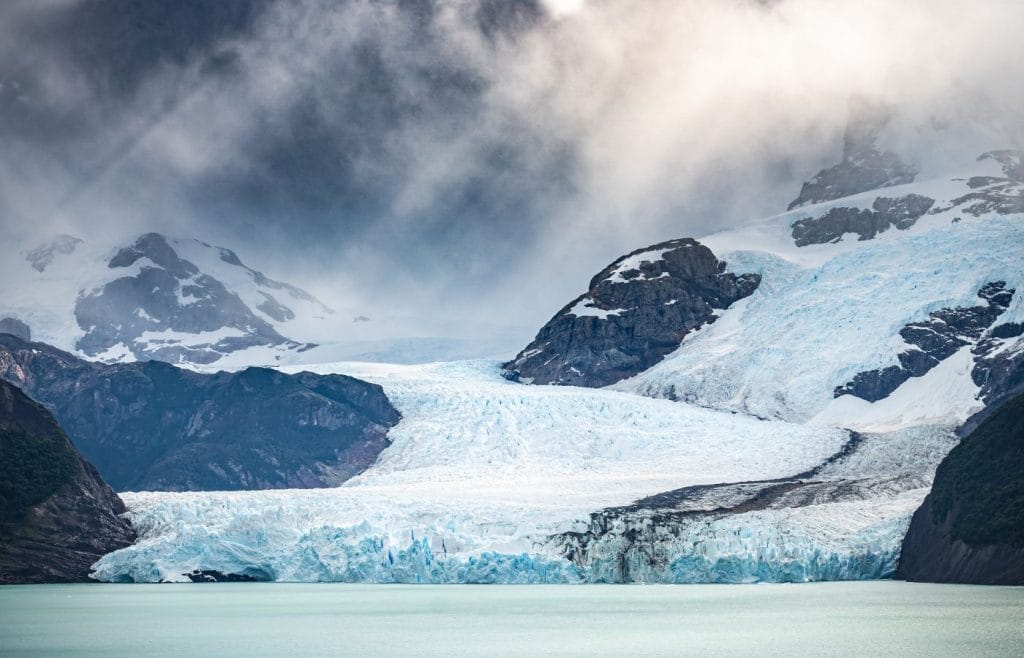
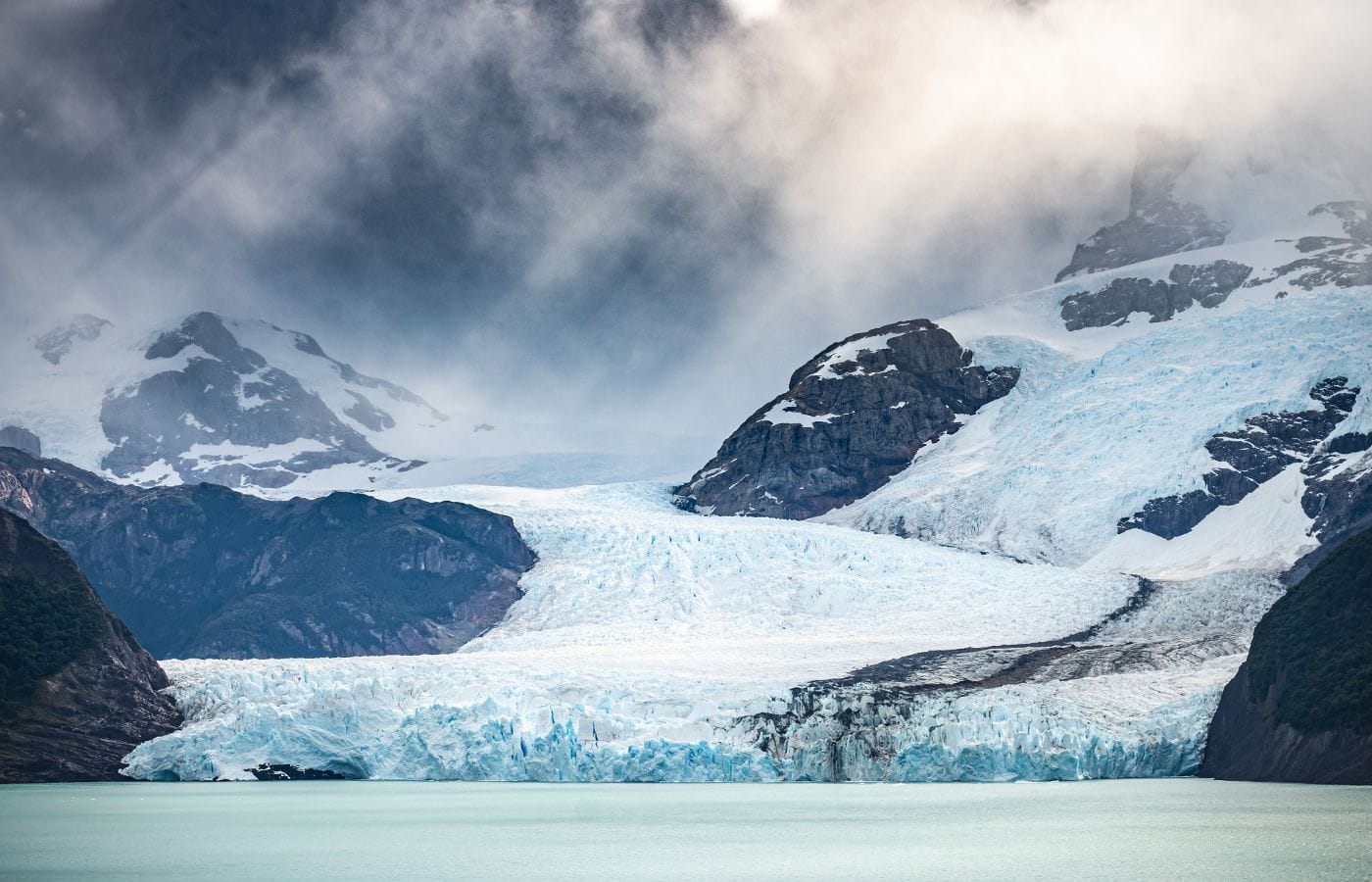
Glaciers are defined by their shape and location. The main types are ice fields, the outlet glaciers that flow from them, valley glaciers, hanging glaciers, and cirque or mountain glaciers. Los Glaciares National Park contains examples of almost all of these: the Upsala and Viedma glaciers flow from the Southern Patagonian Ice Field; the Seco glacier is a hanging glacier.
We've been sailing among these glaciers since 1980, and one of the things we enjoy most is seeing passengers realize that no two are alike. This guide explains the differences.
Types of glaciers according to their shape
| Type | What is | Example in the Park |
|---|---|---|
| Icefield | A large mass of ice covering a mountainous region, from which the peaks protrude. | Southern Patagonian Ice Field |
| Discharge glacier | Tongue of ice draining from an ice field into the valleys | Uppsala, Viedma, Spegazzini |
| Valley glacier | Ice channeled through a valley, shaped like a frozen river | The tongues that descend to Glacier Bay |
| Hanging glacier | A glacier that remains suspended on a hillside or high valley, without reaching the bottom. | Dry Glacier |
| Cirque or mountain glacier | Small glacier nestled in a hollow high on a mountain | Snowfields and small glaciers on the peaks surrounding the lake |
The categories are not closed compartments: the same glacier can be a discharge glacier, because it originates in the ice field, and a valley glacier, because it flows down channeled between mountains.
The ice field: the factory
It all starts at the top. The Southern Patagonian Ice Field, shared with Chile, is the third largest freshwater reserve on the planet. There, snow accumulates year after year, compacts, and transforms into ice. This ice doesn't stay still: its own weight causes it to flow to the edges and spill into the valleys. We explain this in our article on the Southern Patagonian Ice Field.
Discharge and valley glaciers: the giants
The largest glaciers in the Park are discharge tongues from the ice field:
- Upsala Glacier: 765 km², larger than the City of Buenos Aires and one of the largest in South America. It ends at the North Arm of Lake Argentino.
- Viedma Glacier: The longest in Los Glaciares National Park. It ends at Lake Viedma, near El Chaltén.
- Spegazzini Glacier: the highest in the Park, with walls up to 135 m above the lake, in the Bay of Glaciers.
As they flow down through channels, these glaciers behave like valley glaciers: they adapt to the curves, crack at changes in slope, and build up moraines on their edges, as we explained in what moraines are.
Hanging and cirque glaciers: the high-altitude ones
Not all glaciers reach the lake. The Dry Glacier , which you can see on the boat trip past Upsala, is a hanging glacier: it descends the mountain and stops on the slope, without ever reaching the water. That's why it doesn't produce icebergs. We explain this in Dry Glacier: What is a hanging glacier?
Higher still, in the hollows of the summits, lie small cirque glaciers. They are responsible for many features of the alpine landscape: they carve out amphitheater-shaped basins that, when the ice melts, sometimes fill with water and form high-altitude lakes.
Depending on how they end up: in the water or on land
Another way to classify them is to look at their forehead:
- Lakefront glaciers: They end up in a lake and lose ice through calving. The blocks that fall are icebergs. This is the case with the Upsala, Spegazzini, and Viedma icebergs. More at Why do icebergs float?.
- Land front glaciers: They terminate on land and lose ice primarily through melting, feeding rivers and streams. Hanging and cirque icefalls fall into this group.
According to their temperature: temperate glaciers
Patagonian glaciers are temperate: their ice is close to its melting point across much of their mass. This allows for liquid water at their base, which lubricates the contact with the rock and facilitates the ice's movement. In polar regions, on the other hand, glaciers are cold, frozen to their bedrock, and much slower. The fact that the glaciers in the Park are temperate partly explains why they are so dynamic and why they react so quickly to climate change.
Several types of glaciers in a single day
The All Glaciers Navigation tour is a hands-on lesson in glaciology: you'll see icebergs and the face of the Upsala Glacier, a discharge glacier; the hanging glacier, the Heim Glacier; and the Spegazzini Glacier, the tallest in the park. From the Spegazzini Base viewpoints, you'll see the Spegazzini, Heim, and Peineta Glaciers together. It departs from 8:30 AM to 16:00 PM (from April to August, from 9:30 AM to 17:00 PM), with daily departures from September to April and every other day from May to August. Check availability and current rates on the tour's website. For a complete overview, you can also see the main glaciers of El Calafate.
FAQ
What are the types of glaciers?
According to their shape, the main ones are ice sheets and ice fields, discharge glaciers, valley glaciers, hanging glaciers and cirque or mountain glaciers.
What is a discharge glacier?
It is a tongue of ice that drains an ice field into the valleys. The Upsala and Viedma glaciers are discharge glaciers of the Southern Patagonian Ice Field.
What is a hanging glacier?
It is a glacier that remains suspended on a hillside or high valley without reaching the bottom. The Dry Glacier, which can be seen on the All Glaciers Navigation, is an example.
Why do some glaciers produce icebergs and others don't?
Icebergs that end in a lake lose ice through calving, which forms icebergs. Icebergs that end on land, like hanging icebergs, lose ice through melting.

