

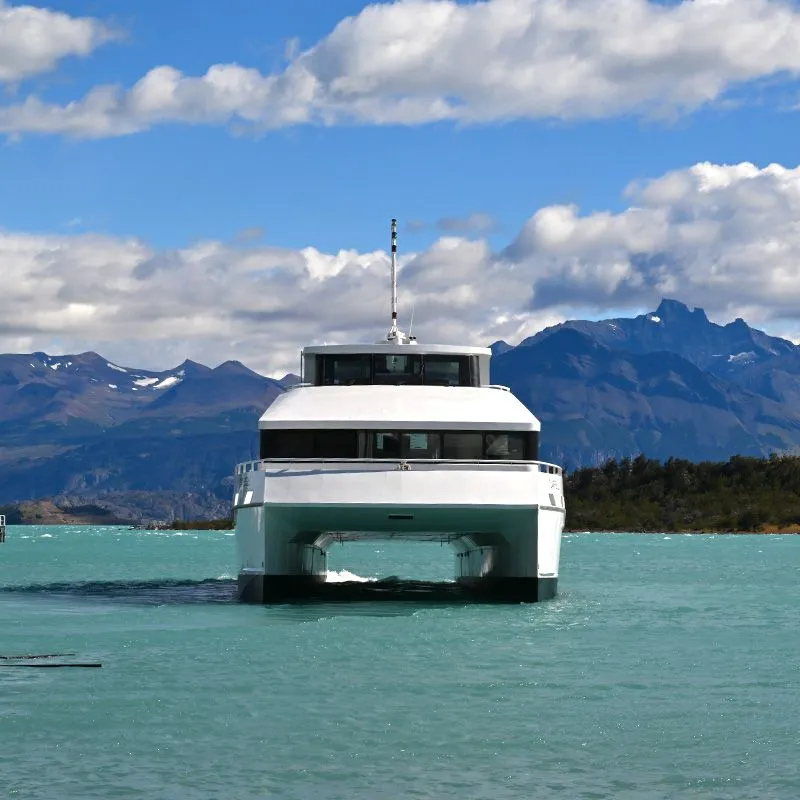
Seasickness while sailing to glaciers is rare. Lake Argentino is a freshwater lake, with no swell or ocean waves, and the catamarans rest on two hulls, making them very stable. In strong winds, there may be some movement in open sections, but it's easily managed with a few simple precautions.
We've been sailing Lake Argentino every day since 1980, and the question always comes up, especially from those who have ever experienced seasickness. We'll tell you about the lake's behavior, what our boats are like, and what to do if you know you're prone to seasickness.
Why doesn't Lake Argentino move like the sea?
Seasickness is caused primarily by the long, repetitive motion of ocean waves: the ship rises and falls for hours, and the inner ear cannot adjust to what the eyes see. This type of wave doesn't exist on Lake Argentino. There are no tides or swells; what exists is a shorter wind wave, which forms when strong winds blow across open surfaces.
Furthermore, a significant portion of the All Glaciers Navigation route takes place on the North Arm, a narrower section surrounded by mountains, accessed through the Devil's Mouth. Conditions vary from day to day and from one section to another, but overall the trip is calm. If you'd like to learn more about the lake, we recommend reading our article on Lake Argentino.
Catamarans: why they are stable
Our entire fleet consists of aluminum-hulled catamarans. A catamaran rests on two separate hulls, giving it a wide base and reducing lateral rolling, which is the movement that causes the most seasickness.
| Catamaran | passengers | Length | Year |
|---|---|---|---|
| Quo Vadis | 300 | 31,71 m | 2006 |
| Upsala Connection | 208 | 28,5 m | 2004 |
| New Leon | 208 | 28,7 m | 2005 |
| Campbell | 184 | 26,4 m | 2024 |
| Patagonia Infinity | 162 | 24,45 m | 2008 |
They're large boats for a lake, with enclosed lounges, a cafeteria, and outdoor decks. Learn about each one in the article about the catamarans that sail to the glaciers.
How to avoid seasickness: practical tips
If you're prone to it, these habits make all the difference:
- Choose where you sit well. The movement is felt least in the center of the ship and on the lowest deck.
- Look at the horizon. Focusing your gaze on the mountains or the coast helps the brain to organize what the body feels.
- I went outside for some fresh air. Outdoor decks are ideal: fresh air, a wide horizon and, incidentally, the best photos.
- Avoid reading or looking at your cell phone for too long at a time. while we navigate through open stretches.
- Have a light breakfast. Eat neither on an empty stomach nor on a heavy one. Avoid fried foods and excessive coffee before boarding.
- Stay hydrated with water during the trip.
- If you take medication for motion sickness, Consult your doctor or pharmacist beforehand to find out which one is right for you and when to take it: almost all of them work better if taken before boarding.
And if you feel unwell on board, let the crew know: they are trained to help you find the most comfortable place on the ship.
What happens if there is wind or bad weather?
In Patagonia, the wind is part of the landscape. Our policy is clear: sailing is not suspended due to bad weather; in the event of an extraordinary weather event, the situation is assessed on a case-by-case basis. This means that on windy days we sail anyway, with boats prepared for these waters and crews who know every corner of the lake.
A gray or windy day isn't a bad day for glaciers: with overcast skies, the blue of the ice appears more intense. The important thing is to dress warmly in layers and wear a windbreaker.
The pause on the ground also helps
Something that puts many passengers at ease: you don't spend the whole day on the ship. On the All Glaciers Cruise , after exploring the Upsala icebergs and the Seco, Heim, and Spegazzini glaciers, we disembark at Spegazzini Base to walk the trails and walkways, view the Peineta Glacier from the lookouts, and visit the Spegazzini Refuge. This break on solid ground is helpful for those sensitive to movement.
Something similar happens on the Viedma Adventure: after 40 minutes of sailing we disembark in Cabo de Hornos Bay to walk to the viewpoint of the Iceberg Bay before continuing towards the glacier.
Elderly people, children and pregnant women
The cruise is suitable for all ages: Todo Glaciares has no minimum age and is 100% accessible. With children, the best approach is to keep them entertained by looking out the window, on deck, and wearing warm clothing. If you are traveling with seniors, our article on glaciers with older adults offers tips on pace and comfort. For any specific health conditions, including pregnancy, consult your doctor before traveling.
Sail peacefully towards the glaciers
Seasickness shouldn't stop you from seeing the Upsala and Spegazzini Glaciers from the water. With a well-chosen spot, a view of the horizon, and some fresh air, most passengers enjoy the trip without any problems. Check availability and current fares on the All Glaciers Navigation website.
FAQ
Is it common to get seasick while sailing to glaciers?
It's not common. Lake Argentino has no ocean waves or tides, and the catamarans are very stable; only with strong winds might there be some movement in open sections.
Where is the best place to sit to avoid getting seasick on the boat?
Stay in the center of the ship and on the lowest deck, where you'll feel the least movement. Looking at the horizon and going outside for some fresh air also helps.
Is it advisable to take something for seasickness before sailing?
If you are prone to this, consult your doctor or pharmacist about which medication is right for you and when to take it; they generally work best if taken before boarding.
Is sailing suspended if there is wind?
Sailing is not suspended due to bad weather; in the event of an extraordinary weather event, the situation is evaluated on a case-by-case basis. The catamarans and crews are prepared for the Patagonian winds.
Do you spend all day on the boat at Todo Glaciares?
No. The voyage includes a landing at the Spegazzini Base, with trails, walkways, viewpoints and the Spegazzini Refuge, providing a break on dry land.


