

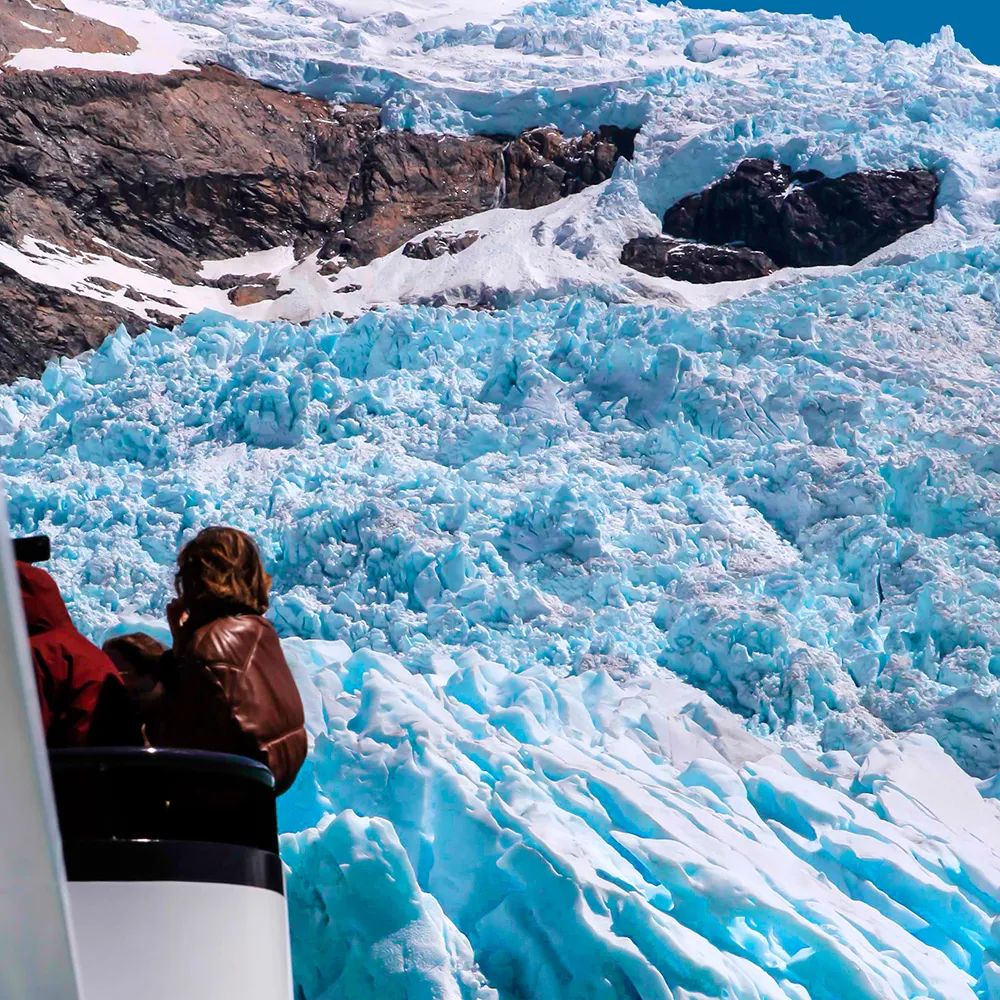
Glacial crevasses are fractures that open in the ice when it stretches or changes slope as it flows. Seracs are the blocks and towers of ice that remain between intersecting crevasses. Reading them from the ship tells you where the glacier is accelerating, where it bends, and where it is about to calve.
We've been sailing past glaciers since 1980, and on the Viedma Adventure, the ship approaches the Viedma Glacier, the largest in Los Glaciares National Park, with its surface crisscrossed by crevasses and displaying shades of blue. This article is a short guide to seeing that surface with new eyes.
What are glacial crevasses and why do they form?
The ice in a glacier behaves in two ways simultaneously. At depth, under the weight of the entire mass above it, it deforms slowly, almost like very thick paste. In the first few meters, however, it is rigid and brittle. When the glacier stretches, bends, or passes over a drop in the terrain, this surface layer does not move with it and breaks.
The result is crevasses: fractures that can be narrow or wide, short or hundreds of meters long. They don't reach the bottom of the glacier, because at depth the ice closes in on itself, but on the surface they create a map of the forces acting upon it.
Types of cracks that can be recognized
| Type | How they look | What do they indicate? |
|---|---|---|
| transversal | They cross the glacier from side to side. | The glacier accelerates or descends a steeper slope. |
| Longitudinal | Parallel to the direction of flow | The ice widens, for example when it emerges from a narrow valley |
| Marginal | At the edges, diagonally upwards | Friction of the ice against the slopes, which slows down the sides |
| Near the front | Deep cracks parallel to the front | Areas that may break away into the lake |
On a real glacier, the different types of ice mix. Observing where their orientation changes is a simple way to understand where the ice is moving fastest.
What is a serac?
When two sets of crevasses intersect, the ice is split into blocks. Over time, the sun and wind round or sharpen these shapes, and towers, needles, and detached walls appear: seracs. They are very common in areas where the glacier descends a steep slope, and also near the terminus, where the ice loses its footing as it reaches the water.
Seracs are inherently unstable. Many of the calving events visible from the ship begin with a serac tilting and falling. This is why cruises maintain a safe distance from the glacier face, a point we explain in our article on why the ship doesn't approach the glacier more closely.
Why do the cracks look so blue?
Inside a crevasse, light passes through a greater thickness of compacted ice before reaching your eyes. Ice absorbs red wavelengths more readily and allows blue wavelengths to pass through, so the deeper the fracture, the more intense the color. This is the same phenomenon we explained in why glacial ice is blue.
The dark bands that sometimes accompany the cracks are something else: sediments and rock that the glacier drags from its edges and that are exposed when the ice opens up.
How to read the Viedma Glacier from the boat
On the Viedma Adventure , after the hike to the viewpoint overlooking Iceberg Bay, we return to the boat and approach the face of the glacier. This is the best time to practice this reading:
- Start with the surface in the distance: Look for cracks that cross the glacier; they tell you where it accelerates.
- Look down at the edges: The marginal cracks show how the rock slows down the sides.
- Look at the front: Look at the seracs and the cracks parallel to the water. These are the most active areas.
- Pay attention to the color: The deepest blues mark recent fractures or very compact ice.
- Listen: The creaking sounds accompany the opening of cracks. We reported on it in the sound of glaciers.
The guide on board accompanies that moment with the interpretation of the glacier, and then comes the ice fishing: a piece of the Viedma for the toast.
Also in Lake Argentino
The same observation applies to the All Glaciers Navigation , in front of the Upsala and Spegazzini glaciers. At Spegazzini, with walls up to 135 meters above the lake, the seracs at the front are clearly visible. And at the Dry Glacier, a hanging glacier that doesn't reach the water, you can see how the ice fractures as it emerges over the slope.
See a glacier up close
Knowing the difference between a crevasse and a serac transforms a white wall into a landscape that can be interpreted. If you'd like to do this in front of the park's largest glacier, check availability and current rates on the Viedma Adventure website.
FAQ
What are glacial crevasses?
These are fractures that open in the rigid surface layer of the ice when the glacier stretches, changes slope, or rubs against the slopes as it flows.
What is a serac?
It is a block or tower of ice that becomes isolated between intersecting crevasses. They are unstable and often cause icefalls at the front.
How deep are the cracks?
It varies a lot, but they don't go all the way through the glacier: at depth, the pressure causes the ice to deform instead of break, and the cracks close up.
Where are the cracks visible in the Viedma Adventure?
Approaching the face of the Viedma Glacier, after the hike in Cape Horn Bay. From the boat, you can see the crevasses, the seracs, and the blue hues of the ice.


