

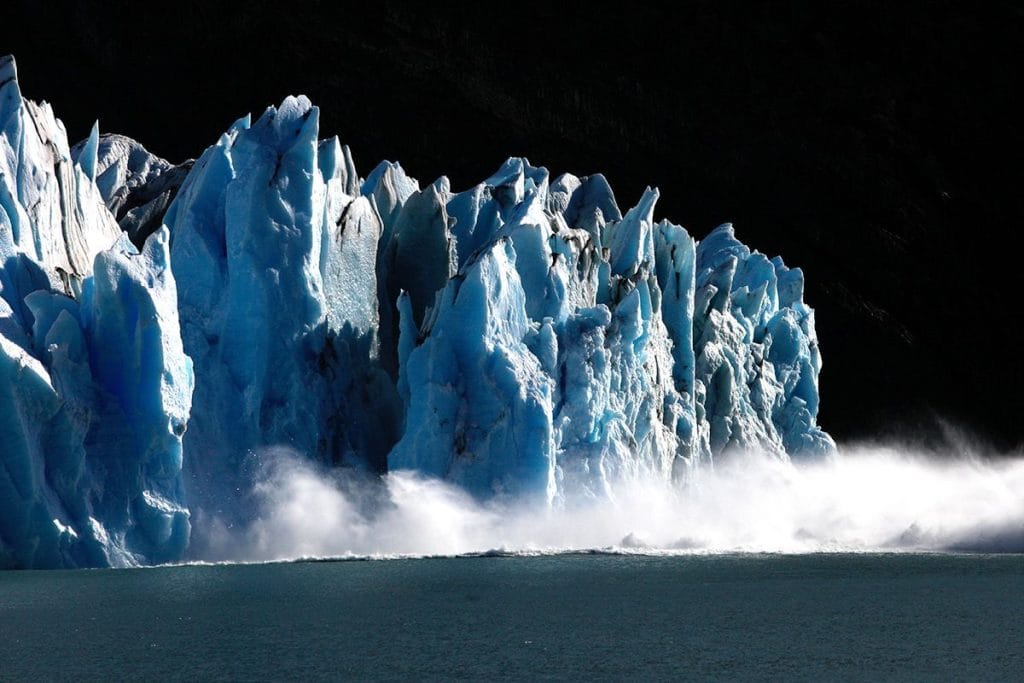
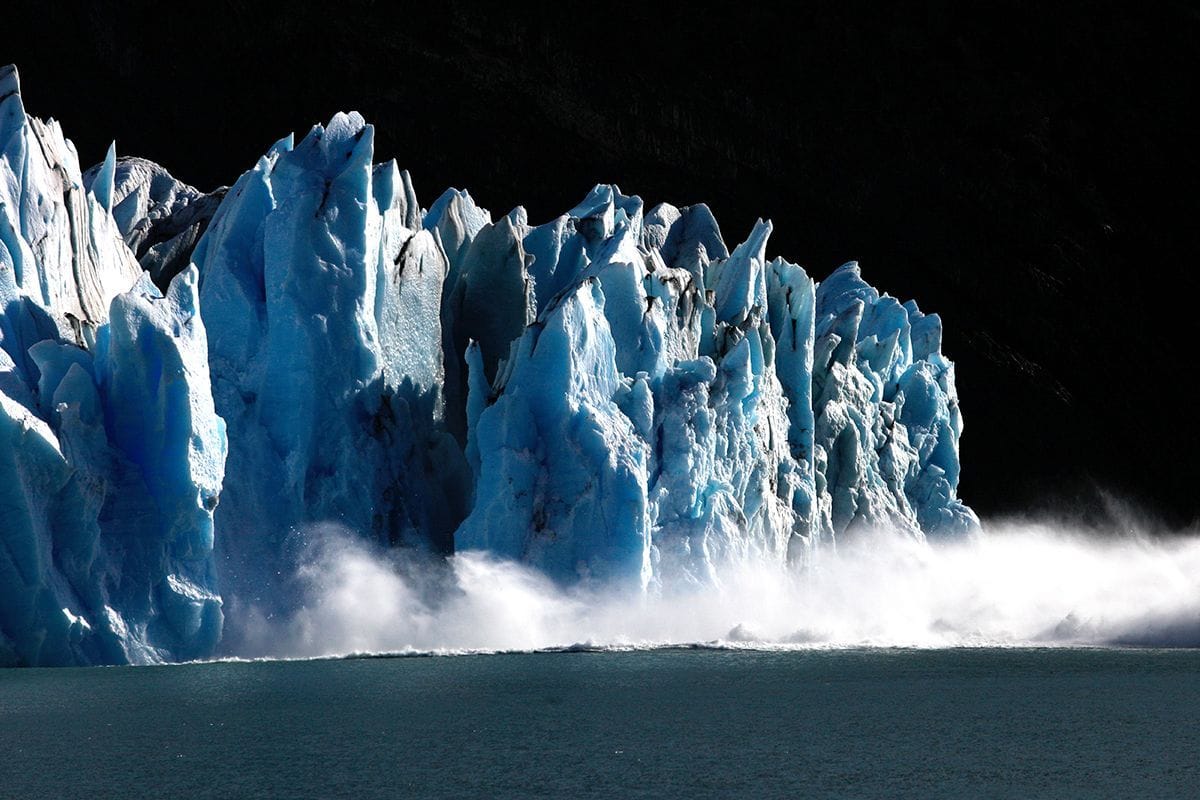
Some interesting facts about glaciers: ice appears blue because it absorbs red light; it crunches in a glass because it releases air trapped for centuries; it moves like plastic; and the Upsala Glacier, at 765 km², is larger than the city of Buenos Aires. Here are 20 facts.
These are facts we've been collecting on board for decades: we've been sailing among glaciers since 1980. We've organized them into four groups so you can memorize them on deck.
Interesting facts about glaciers: the ice inside
- A glacier begins as snow. Snow that does not melt in summer compacts year after year, passes through an intermediate state called firn, and ends up becoming dense ice.
- Glacial ice holds ancient air. As the snow compacts, small air bubbles from the time it fell become trapped.
- That's why it crunches in the glass. When that ice melts, the compressed bubbles are released with small popping sounds. You experience it during ice fishing at Aventura Viedma; we explain it in ice fishing.
- Blue is not a reflection of the sky. Very compact ice absorbs the red part of the light spectrum and allows the blue to pass through. The less air there is, the bluer it appears. We'll tell you more in Why are glaciers blue?.
- White ice has more air. The white surfaces of the glacier are ice with many bubbles or fractured, which reflects all the light.
How they move
- The glaciers flow. Under its own weight, ice slowly deforms, like a plastic material, and can also slide over rock.
- Not all of the glacier moves at the same speed. The center usually moves faster than the edges, which rub against the slopes.
- Cracks are signs of stress. They appear where the ice stretches, for example at curves or changes in slope.
- A glacier can retreat even as it flows forward. If it loses more ice at the front than it receives, its front will move further and further back. The Upsala Glacier is a well-studied example; we discussed it in the retreat of the Upsala Glacier.
- The icebergs turn over. As they melt unevenly, they change their balance and can suddenly spin, showing their bluer side.
The glaciers of the Park, in numbers
- A huge park: Los Glaciares National Park has 726.927 hectares and is the largest in Argentina.
- World Heritage: UNESCO declared it in 1981.
- 47 major glaciers: These are the ones the Park has, fed by the Southern Patagonian Ice Field.
- A world-class freshwater reserve: The Southern Patagonian Ice Field, shared with Chile, is the third largest freshwater reserve on the planet.
- The Uppsala measures 765 km², larger than the City of Buenos Aires, and is one of the most extensive glaciers in South America.
- Spegazzini is the tallest in the Park: Its walls reach 135 m above the lake.
- The Viedma is the largest in the Park and the largest in Argentina.
The traces they leave
- There are glaciers that do not touch the water. The Dry Glacier is a hanging glacier: it remains on the hillside, without reaching the lake.
- The turquoise of the lake is rock dust. Glaciers grind the rock into glacial flour, which remains suspended and gives Lake Argentino its color.
- The lakes are the work of ice. Lake Argentino and Lake Viedma occupy basins carved out by glaciers during ice ages. This explains their long arms and steep slopes, such as those found at Boca del Diablo.
If you want to continue learning terms, we have a glossary of glaciers with 30 words explained in simple terms.
Where to listen to this data live
During the boat trip, the guide tells the story of each glacier as it appears: the Upsala and its icebergs, the Seco clinging to the mountain, the Heim, the Peineta, and the Spegazzini. At the Spegazzini Base, the trail has interpretive stations about glaciology, history, fauna, and flora, and the Spegazzini Refuge has a picture window facing the glacier where you can continue admiring it with something warm in your hand.
Twenty facts, five glaciers
The All Glaciers Navigation tour is a 7-hour cruise, or about 10 hours with transfers, and is the most comprehensive way to see these glaciers firsthand. It departs daily from September to April and every other day from May to August. Check availability and current rates on the tour's website.
FAQ
Why is glacier ice blue?
Because very compact ice absorbs the red part of the light and lets the blue pass through. The less air it contains, the more intense the color.
Why does glacial ice creak when it melts?
Because it retains compressed air bubbles from when the snow turned to ice. As it melts, the air is released with small popping sounds.
Which is the largest glacier in Los Glaciares National Park?
The Viedma Glacier is the largest in the park and the largest in Argentina. The Upsala Glacier, at 765 km², is another giant and one of the largest in South America.
Which is the tallest glacier in the Park?
The Spegazzini Glacier, with walls up to 135 m high above the lake. It can be seen on the All Glaciers Navigation tour and from the viewpoints at Spegazzini Base.


