

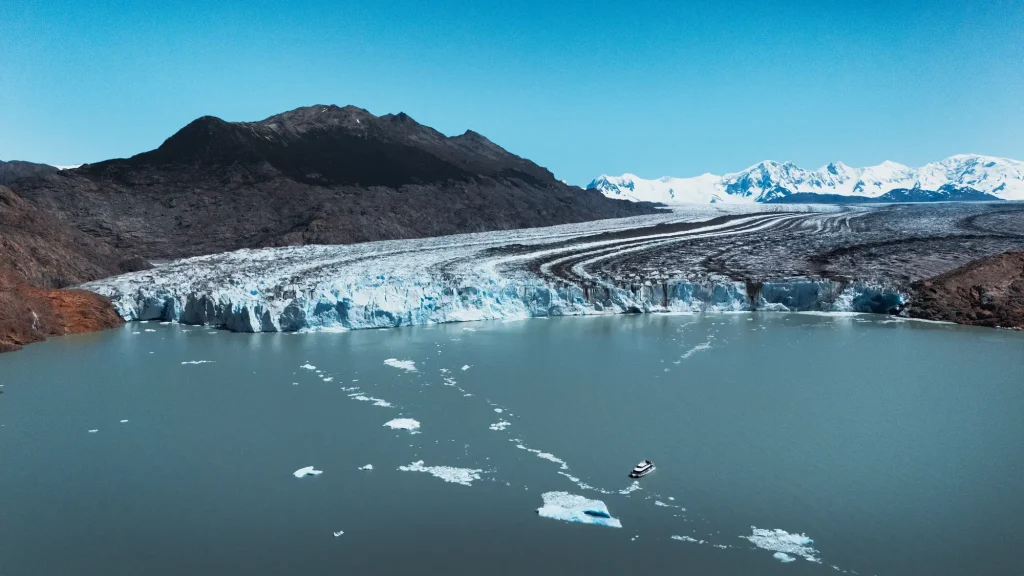
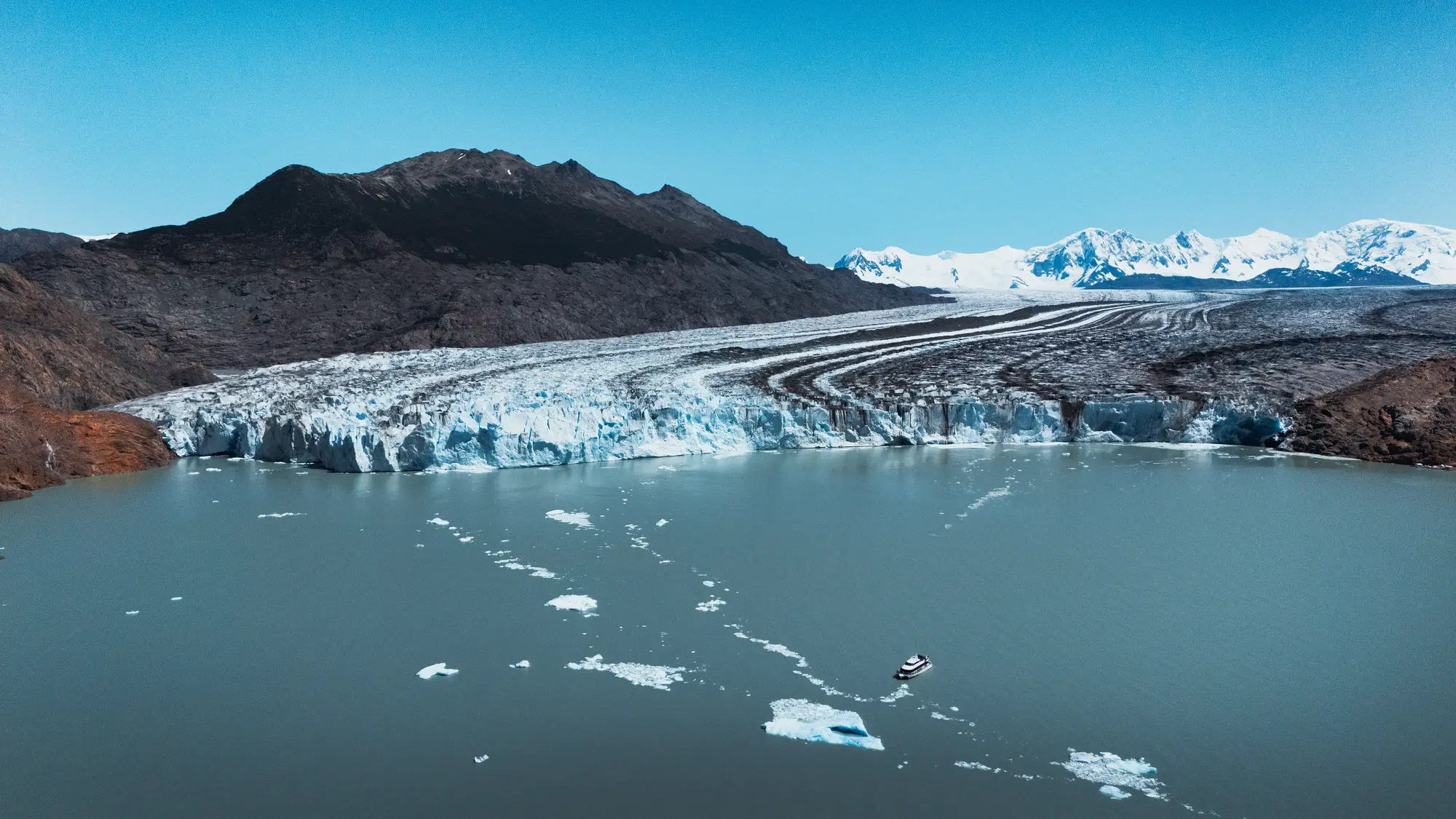
Lautaro Volcano is an active, ice-covered volcano located within the Southern Patagonian Ice Field, on the Chilean side, northwest of the Viedma Glacier. It is considered the most active volcano in this vast ice field, having registered activity several times during the 20th century. Due to its remote location and frequent cloud cover, it is almost never visible.
We sailed across Lake Viedma, at the foot of the glacier that descends from that same ice field, and one of the most frequent questions we get when facing Lake Viedma is whether there are volcanoes in the area. The answer is yes, and this is the most well-known.
Where is the Lautaro volcano?
Lautaro is located in the northern sector of the Southern Patagonian Ice Field, the vast ice mass shared by Argentina and Chile, considered the third largest freshwater reserve on the planet. It lies within Chilean territory, surrounded by kilometers of ice in every direction. There are no roads or trails leading to it: reaching it is a mountain expedition on the ice, reserved for specialists.
Its summit rises from the ice field like any other mountain, covered in snow and ice. That's why, from a distance, it can be mistaken for any other peak in the mountain range. To understand the landscape where it's located, we recommend visiting the Southern Patagonian Ice Field.
Lautaro Volcano: a volcano under the ice
Lautaro is a stratovolcano: a cone formed by successive layers of lava and volcanic material. What makes it special is its surroundings. Few volcanoes in the world are surrounded by an ice field of this scale, and this creates a complex relationship between fire and ice.
- Ash on ice. When such a volcano becomes active, the ash can fall on the snow and become buried in the layers that later transform into glacial ice.
- The heat beneath the ice. Volcanic heat can melt ice from below and alter the behavior of nearby glaciers.
- A natural archive. The layers of ash trapped in the ice serve scientists as time markers: if you know when an eruption occurred, you can date the ice layer that contains it.
The idea of using ice as an archive is part of glaciology, which we explain in how to study a glacier.
Their activity: what is known
Lautaro is considered the most active volcano in the Southern Patagonian Ice Field and is often identified as the northernmost volcano in the Southern Volcanic Zone of the Andes. Several episodes of activity were recorded during the 20th century, with steam plumes and ash emissions.
Regarding the exact dates and magnitude of each event, caution is advised: due to the remoteness of the location, information about some events is limited and could not always be confirmed firsthand. What is clear, however, is that it is an active volcano, part of the natural dynamics of the ice field.
Why is he called Lautaro?
The volcano is named after Lautaro, a 16th-century Mapuche leader who spearheaded the resistance against the Spanish conquest in what is now Chile. He is one of the most revered figures in Mapuche history, and his name appears in many places throughout Chile.
The names of this region tell very different stories: explorers, scientists, navigators. We explore several of them in the origin of the glaciers' names.
Volcanoes and mountains: two common confusions
| What is heard | what you need to know |
|---|---|
| “Fitz Roy is a volcano” | It isn't: it's a granite mountain. The Tehuelche people called it Chaltén, "smoking mountain," because of the clouds that often envelop its summit. |
| “The dark bands on the Viedma Glacier are all volcanic ash.” | Most of these bands are rock and sediment carried by the glacier from the mountains. Ash may be part of what the ice transports, but it's not advisable to attribute every band to a volcano. |
| “You can see it from the road” | It is hidden in the interior of the ice field and is usually covered in clouds; it is not a landscape that can be promised. |
On the most famous hill in the area, look at Mount Fitz Roy.
From volcano to lake: the Viedma Glacier
Although it's not visible, the Lautaro Glacier is part of the same ice system that feeds the Viedma Glacier, the largest in Los Glaciares National Park. Facing its face, from the deck, you can truly grasp the scale of this icy world: crevasses, shades of blue, the sound of the ice, and icebergs floating on Lake Viedma. There, the guide explains how the glacier forms and moves, and it's the perfect time to ask all your questions about the ice field behind it.
Sail to the glacier that descends from the Ice Field
The Viedma Adventure departs from Puerto Bahía Túnel, 18 km from El Chaltén, and lasts 4 hours, from 10:30 AM to 14:30 PM. It includes a boat trip on Lake Viedma with views of the Huemul Massif, a hike to the Iceberg Bay viewpoint, a close-up view of the Viedma Glacier, and a toast with ice from the glacier. It departs daily from September to April and every other day plus Saturdays from May to August. If you are staying in El Calafate, the Viedma Full Day Adventure includes the same boat trip. Check the departure schedule, availability, and current rates on the tour's website.
FAQ
Where is the Lautaro volcano?
Inside the Southern Patagonian Ice Field, in Chilean territory, northwest of the Viedma Glacier.
Is the Lautaro volcano active?
Yes. It is considered the most active volcano in the Southern Patagonian Ice Field and recorded several episodes of activity during the 20th century.
Can you see the Lautaro volcano from El Chaltén?
It is hidden inside the ice field and is usually covered in clouds, so it is not usually visible from public access points.
Why is he called Lautaro?
Named after Lautaro, a 16th-century Mapuche leader who led the resistance against the Spanish conquest in what is now Chile.
Is Fitz Roy a volcano?
No. It's a granite mountain. Its Tehuelche name, Chaltén, is usually translated as "smoking mountain" because of the clouds on its summit.


