

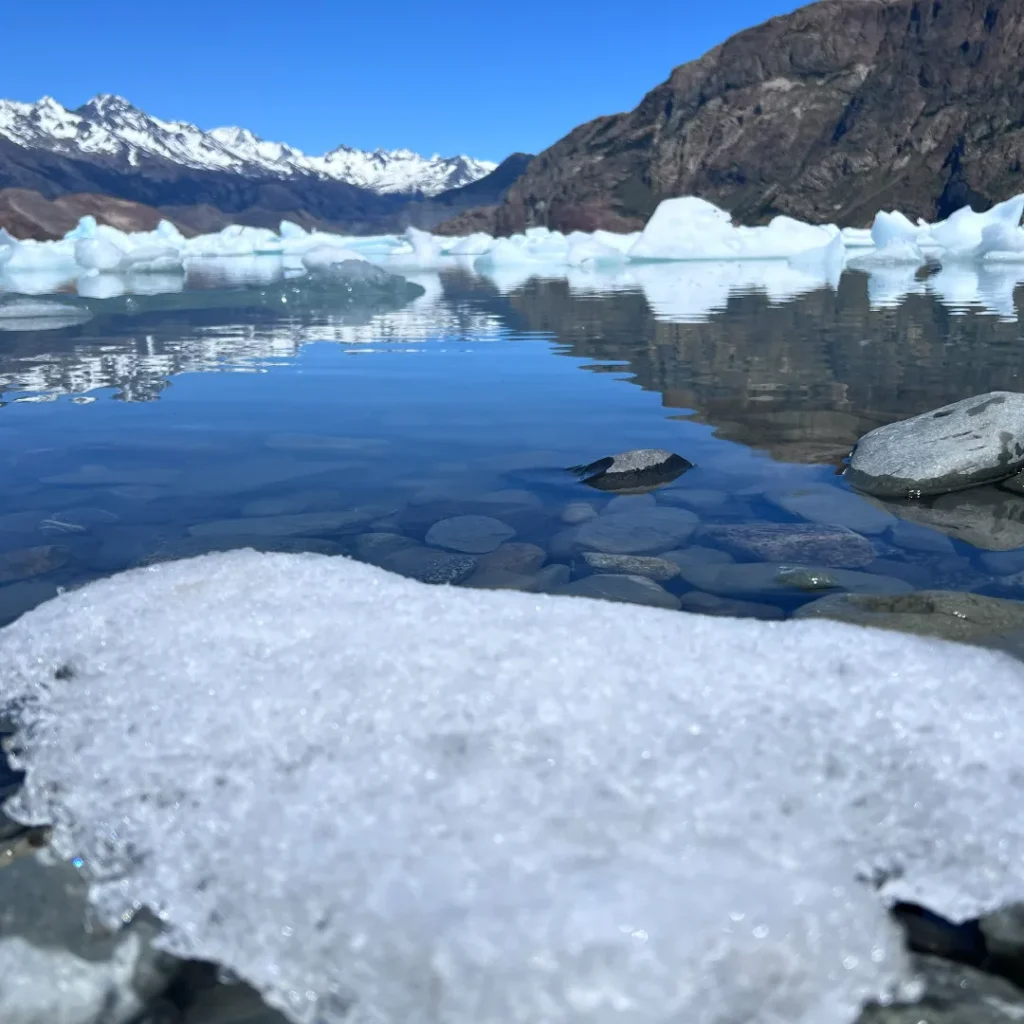

Lake Argentino doesn't freeze in winter because it's enormous and deep: it covers over 1.400 km² and reaches depths of around 500 meters at its deepest points. This mass of water retains heat, the wind constantly mixes it, and for a stable layer of ice to form, the entire water column would need to be cooled, something that the winter in El Calafate doesn't manage to achieve.
We know this from experience: we've been sailing Lake Argentino since 1980, also from May to August, and our catamarans depart in the middle of winter for the glaciers. Here we explain the physics behind it.
Does Lake Argentino freeze over? The short answer
No, the main body of Lake Argentino doesn't freeze. What can happen in cold winters is that thin ice forms on very low shores, in small, sheltered bays, or in shallow lagoons near El Calafate, which cool down quickly. But the open surface of the lake, the part we travel on towards the glaciers, remains liquid.
And the blocks of ice you'll see floating aren't frozen lake water: they're icebergs, fragments that break off from glacial fronts, like the Upsala Glacier. That ice comes from the Southern Patagonian Ice Field, not from the lake water.
Four physical reasons why the lake doesn't freeze
1. It has a lot of water
The larger a lake's volume, the more heat it stores and the longer it takes to cool down. Lake Argentino is the largest lake located entirely within Argentina. During the summer, it accumulates energy, and in winter, it slowly releases it. A freezing night cools the surface, but it's not enough to alter such a vast thermal reserve.
2. The densest water is at 4 °C
Freshwater has a unique property: it is denser at around 4°C than at 0°C. When the surface of a lake cools to this temperature, the water sinks and warmer water rises from below. For the surface to reach 0°C and begin freezing, the entire water column must first cool to 4°C. In a deep lake like Lake Argentino, this process would require a much longer and colder winter than the one experienced in this region.
3. The wind mixes it up all the time
The Patagonian wind, which blows mostly from the west, stirs the surface and mixes the water layers. For ice to form, a still, very cold surface layer is necessary. The waves break up this layer before it can solidify, and although loose ice crystals may form, the movement disperses them.
4. Winter in El Calafate is cold, but not extreme.
There are frequent frosts and sub-zero days, but also days with temperatures above freezing. It takes weeks of intense and sustained cold to freeze a large lake. We cover it month by month in our weather guide for El Calafate.
Lakes that freeze and lakes that don't: what differentiates them
| Factor | It helps it freeze | What's happening at Lake Argentino |
|---|---|---|
| Depth | Shallow depth | It reaches around 500 m in its deepest parts |
| In total area | Small, protected mirror | More than 1.400 km² exposed to the wind |
| Wind | Prolonged calm | Frequent wind that mixes the water |
| Cold | Weeks below zero without a break | Frosts interspersed with warmer days |
And isn't the water freezing cold too?
Just because it doesn't freeze doesn't mean it's lukewarm. Lake Argentino is fed by glacial meltwater and water from Lake Viedma, which arrives via the La Leona River, so it's cold year-round. In winter, near the ice fronts, the feeling on deck is intense, and in summer the water isn't suitable for swimming either. To understand how this basin was formed, we recommend reading about the formation of Lake Argentino.
What does this mean for winter sailing?
The fact that the lake doesn't freeze is what allows the All Glaciers Navigation to operate in winter. From the deck, what changes is the surrounding landscape:
- Snowy mountains all the way down, which frame the glaciers with a whiteness that does not exist in summer.
- Low and side lighting, which highlights the cracks and relief of the ice.
- Icebergs that last longerbecause the water and air are colder.
- Fewer passengers on board, with more space on the outer decks for photography.
Details of how the excursion changes at this time of year can be found in All Glaciers in Winter.
Sail the lake in winter
From May to August, the All Glaciers Navigation departs every other day from Puerto Punta Bandera, 47 km from El Calafate. From April to August, the schedule is delayed by one hour, running from 9:30 AM to 17:00 PM. The 7-hour navigation tour takes you past the Upsala, Seco, Heim, Peineta, and Spegazzini glaciers, with a stop at Spegazzini Base. Check the departure schedule, availability, and current rates on the tour's website.
FAQ
Does Lake Argentino freeze in winter?
No. Its large volume, depth, and constant wind prevent an ice layer from forming on the main body of the lake. Thin ice may appear on low shores or in sheltered bays.
What then are the blocks of ice floating in the lake?
They are icebergs: fragments that break off from the fronts of glaciers, like the Upsala. They are not formed by the freezing of lake water.
Is it possible to navigate Lake Argentino in winter?
Yes. The All Glaciers Navigation departs every other day from May to August; it is advisable to consult the departure schedule on the excursion's website.
What is the temperature of the water in Lake Argentino?
It's cold in all seasons because it's fed by glacial meltwater. It's not suitable for swimming.


