

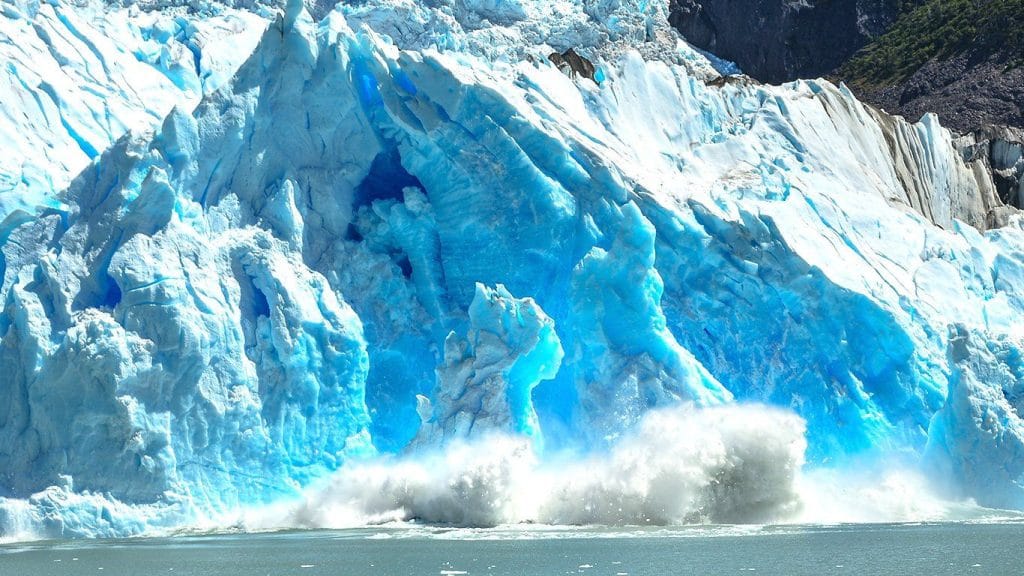
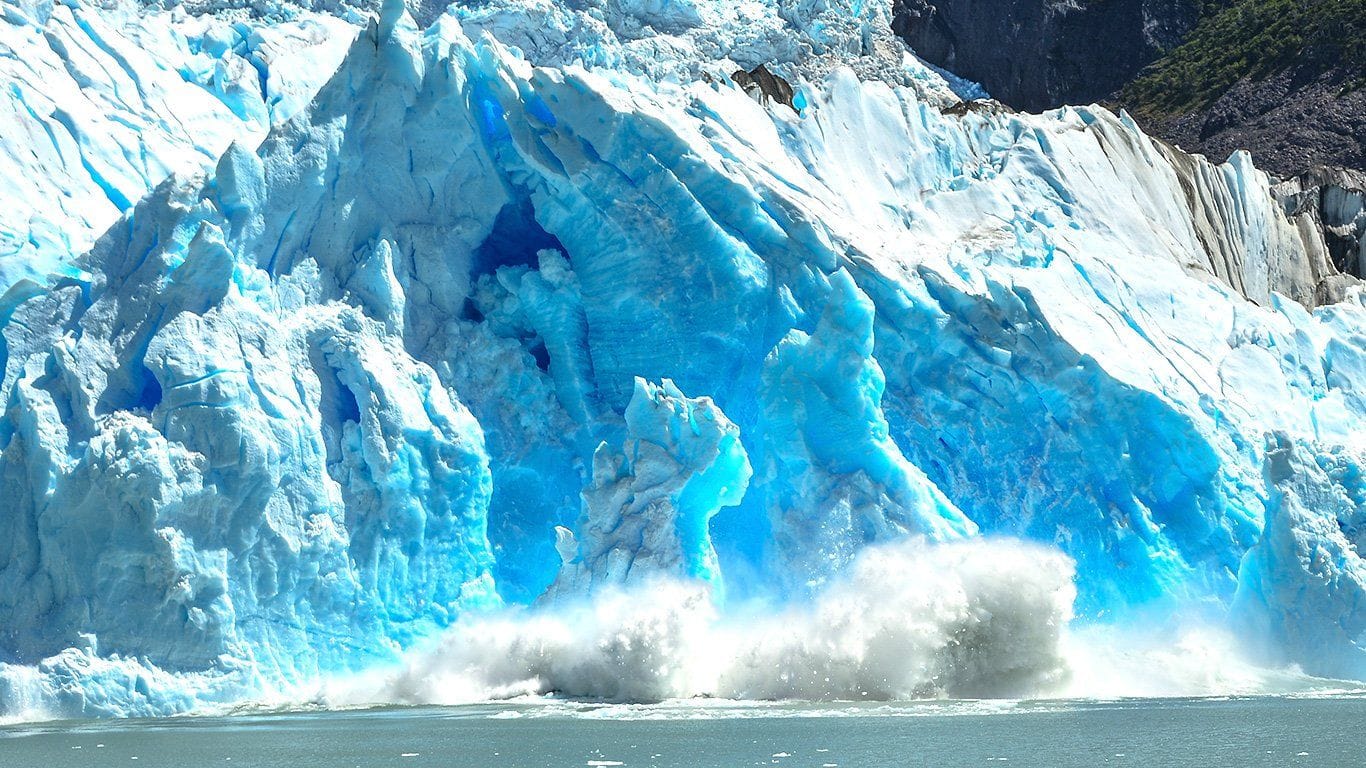
The sound of glaciers has a physical explanation: the ice moves, tenses, and breaks. The creaking sounds come from crevasses opening within the glacier; the thunderous noises, from blocks breaking off from the face and falling into the lake; and the crackling of icebergs, from air trapped for centuries escaping as the ice melts.
We've been sailing past these ice fields since 1980, and there's something passengers mention almost as much as the color blue: the sounds. When the engine slows down and the ship comes to a standstill facing a glacier, the silence is short-lived. This article explains what each sound is.
Why does a glacier make noise? The ice is in motion.
A glacier is not a stationary block. It is a mass of ice that flows, very slowly, from the higher elevations where snow accumulates toward its terminus. This movement is not uniform: the center advances faster than the edges, the surface faster than the bottom, and the ice has to adapt to an uneven bedrock.
When the tension exceeds the ice's strength, it fractures. Each fracture releases energy, and some of that energy travels as sound. That's why an active glacier makes noise even if you don't see anything falling.
The sounds of the glaciers, one by one
| Sound | What produces it? | When is it heard |
|---|---|---|
| Dry crackle or snap | Cracks that open or widen within the ice | Facing the glacier, with the ship stopped |
| Thunder or bang | A block breaks off from the front and falls into the water | Unpredictably, more often in warm weather |
| Deep, prolonged roar | Large landslides or internal collapses | It happens rarely, and it's remembered forever. |
| Sizzling or bubbling | Compressed air escaping from melting ice | Alongside icebergs and pieces of floating ice |
| Wave surge | The wave that causes a landslide upon reaching the coast | A few moments after the crash |
Why does the noise come after the image?
It's one of the most surprising things on board: you see a block of ice fall and the sound arrives a moment later. The reason is that light travels much faster than sound. The farther away the glacier's face is, the greater the delay between what you see and what you hear.
Our guides often say that when faced with a glacier, it's best to look with your eyes, not your ears: if you wait to hear a roar before turning your head, the iceberg will already be in the water. That same distance is part of navigational safety, as we explain in why the ship doesn't get any closer to the glacier.
The crackling of the icebergs: an air from another era
Glacial ice forms from the compaction of snow over many years. In this process, tiny air bubbles become trapped and compressed by the pressure of the glacier itself. When an iceberg or chunk of ice melts in the lake, these bubbles are released with a sound similar to that of a fizzy drink.
That same ice, transparent and full of bubbles, is what we use on the Viedma Adventure for "ice fishing": we collect a piece of the Viedma Glacier and toast with it on board. If you hold the glass to your ear, you'll hear it too. We describe the ritual of ice fishing on the Viedma Glacier.
Where can they be heard best during our voyages?
- Facing the Viedma Glacier: in the Viedma AdventureAfter the walk in Cape Horn Bay, the boat approaches the front of the glacier, with its cracks and blue tones, and the guide interprets what is seen and heard.
- In Glacier Bay: in the All Glaciers Navigation, opposite the Spegazzini, with walls up to 135 m above the lake, and opposite the Heim.
- From Spegazzini Base: On the walkways and viewpoints, far from the engine, the sound of the glacier comes through clearly.
- Among the icebergs: In the North Arm, near Upsala, the floating ice also creaks and settles.
How to listen to a glacier
- I went out on deck: Inside the room, the glass and the conversations block almost everything.
- Be quiet for a few minutes: The creaking noises are more frequent than the detachments, but they are also softer.
- Look at the front, not the water: The landslides begin at the top, with a crack opening up or ice dust falling.
- Record video, not just photos: Audio is what's most easily forgotten, but it's also what best brings the moment back to life. You can find more tips at How to photograph glaciers from a boat.
There's no way to predict a calving event. Some days the ice is very active, and other days it's almost calm; that's part of observing a living, natural system.
Hear the ice in person
No recording can replace standing before a wall of ice and hearing it creak. If you'd like to hear it, you can do so on the Viedma Adventure, in front of the park's largest glacier, or on the All Glaciers Navigation tour, in front of the Spegazzini Glacier. Check availability and current rates on each excursion's page.
FAQ
Why do glaciers creak?
Because ice moves slowly and unevenly. This deformation creates stresses that open cracks, and each fracture produces a creaking or cracking sound.
What is the loud noise heard in front of a glacier?
It's usually a calving event: a block of ice that breaks away from the ice face and falls into the lake. The sound arrives an instant after the image because light travels much faster than sound.
Why does glacial ice bubble as it melts?
Because it contains air bubbles trapped when the snow compacted and turned into ice. As it melts, that compressed air escapes with a sound similar to that of a fizzy drink.
Are rockfalls always heard while sailing?
They cannot be guaranteed. Creaking noises are frequent, but rockfalls depend on the glacier's activity that day and cannot be predicted.


