

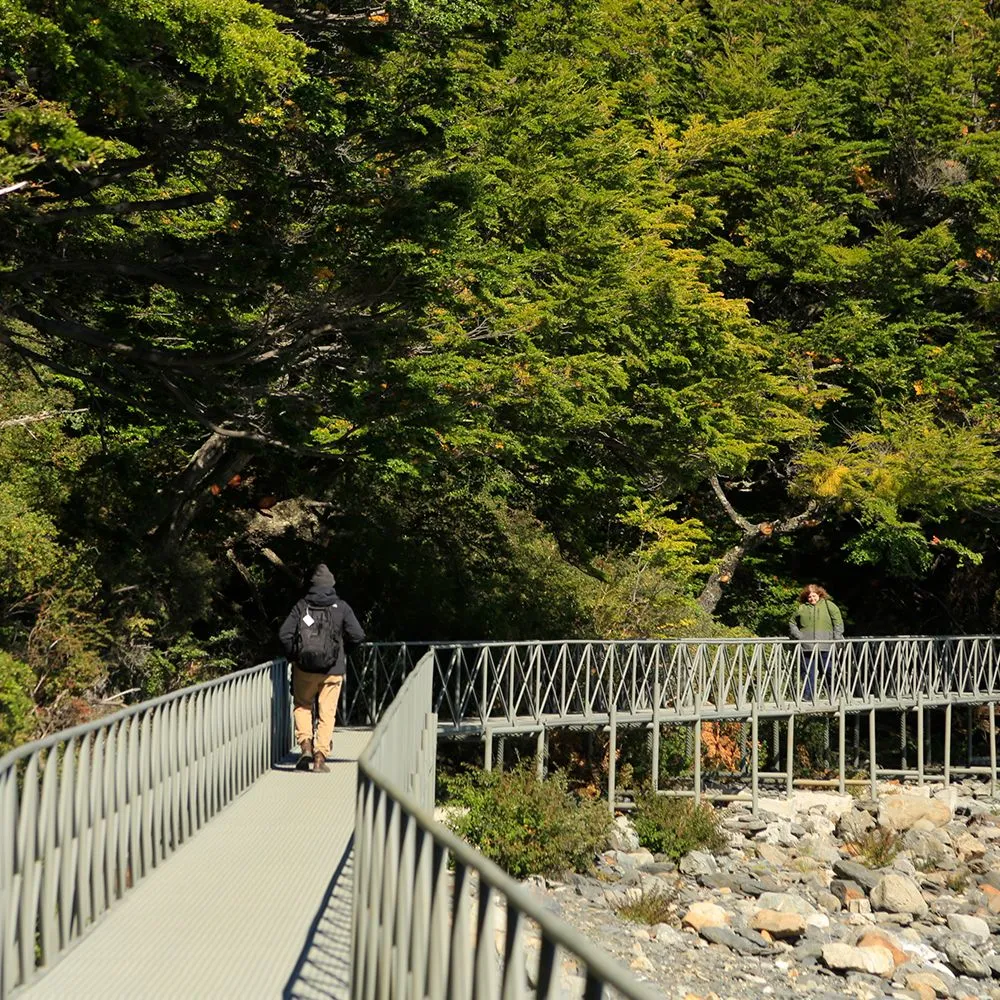
The Patagonian Andean forest is the strip of woodland that grows at the foot of the Andes Mountains, between the glaciers and the steppe. In Los Glaciares National Park, it is composed mainly of lenga, ñire, and guindo trees, along with shrubs such as the notro and calafate. It can be seen from the ship and explored on foot at Spegazzini Base.
Since 1980 we have sailed between these coasts and learned to read the forest like a calendar: by its color we know what part of the year it is.
What is the Andean Patagonian forest?
It is a cold temperate forest dominated by trees of the genus Nothofagus . At this latitude, it occupies a narrow strip: to the west it is limited by ice and to the east by the lack of rain, because the Andes Mountains block the moisture arriving from the Pacific. Therefore, traveling towards the glaciers, the landscape changes from dry steppe to forested slopes in just a few kilometers.
The species you will recognize
| Species | How to recognize it | When does it look best? |
|---|---|---|
| Lenga (Nothofagus pumilio) | Tall tree, small leaves with wavy edges; forms dense forests on the slopes | Autumn, when it turns red and yellow |
| Ñire (Nothofagus antarctica) | Shorter and more twisted, it grows in damp or poor soils and at the edge of the forest | Autumn, with reddish tones |
| Guindo (Nothofagus betuloides) | Evergreen leaves, green in all seasons; prefers the dampest areas near the ice | At any season |
| Notro (Embothrium coccineum) | Shrub or small tree with tubular red flowers | Spring and the beginning of summer |
| Calafate (Berberis microphylla) | Thorny shrub, yellow flowers and dark blue fruit | Summer, with ripe fruit |
How the forest changes with the seasons
- Spring Season: New leaves sprout from lenga and ñire trees, a light green color, and the red flowers of the notro tree appear.
- Summer: The forest is at its most intense green and the calafate bushes are laden with fruit.
- Fall Season: The most photographed season. Lenga and ñire trees, which lose their leaves, turn yellow, orange, and red, contrasting with the blue of the ice and the turquoise of the lake.
- Winter: The deciduous trees are left bare and the cherry tree brings the green; with snow, the forest turns white and gray.
Where to see the Patagonian Andean forest on the All Glaciers Navigation
From the deck of the All Glaciers Navigation, the forest accompanies a good part of the journey: it appears on the slopes as the ship advances through the northern arm, and frames the Seco, Heim, Peineta and Spegazzini glaciers.
But the best place to experience it firsthand is at Spegazzini Base. From the landing, an accessible trail winds through the forest to the Spegazzini Refuge and features interpretive stations about glaciology, history, fauna, and flora. It's the perfect spot to see a lenga tree up close, touch its bark, and witness how the forest grows just meters from a glacier. We'll tell you how to make the most of your time on land at Spegazzini Base.
Details that only those who look closely can see.
- Flag trees: In exposed areas, the west wind causes the treetops to grow towards one side only.
- Old man's beard: Hanging lichens of a greyish-green color on the branches, common in humid and clean-air environments.
- stunted forest: Near the upper limit, the lenga grows low and bushy, almost like a shrub.
- Young soils: Where the ice retreated, vegetation gradually colonized the land; reading that succession is reading the history of the glacier.
The forest is also in El Chaltén
In the north of the park, the lenga and ñire forest surrounds El Chaltén. The Viedma Full Day Adventure includes a hike through this forest to the Chorrillo del Salto waterfall . And if you're interested in the wildlife that lives there, such as the Magellanic woodpecker, you can find more information in our article about the fauna of Los Glaciares National Park.
Walk through the forest in front of the ice
The Spegazzini Base trail is included in the All Glaciers Navigation tour . It departs daily from September to April and every other day from May to August. Check the tour's website for departure schedule, availability, and current rates.
FAQ
What trees make up the Andean Patagonian forest?
Mainly lenga, ñire and guindo trees, of the Nothofagus genus, accompanied by shrubs such as the notro and the calafate.
When does the forest in El Calafate turn red?
In autumn, when the lenga and ñire trees, which lose their leaves, turn yellow, orange and red before becoming bare in winter.
Where can you walk through the forest on the All Glaciers tour?
At Spegazzini Base, where an accessible trail crosses the forest from the landing to the Spegazzini Refuge, with interpretive stations on flora, fauna, glaciology and history.
What is the notro?
It is a shrub or small tree native to the Patagonian Andean forest that is recognized by its tubular red flowers, visible in spring and early summer.
Why is the forest only near the mountain range?
Because the mountain range retains the moisture that comes from the Pacific. To the west it rains more and the forest grows; to the east the climate is dry and the steppe dominates.


